This month seems to me to have been all about horror for me.
Jack Kincaid has just released a remastered, rerecorded version of the prologue to his fantastic Audiobook Drama Hoad's Grim, and it is brilliant. Hoad's Grim is, in my opinion, the most underrated horror audio production out there, and it's free, so if you haven't already plunged into the Grim, then you should. Then, write a review, and let Jack know that you liked it. You can also download the book as a free PDF, and there are rumours of a print version in the works, as well.
The other top performer in the horror audio division right now has to be Harvey by Phil Rossi. With only two episodes left in this gripping tale of murder and sucking earth, Rossi has wracked up the tension and the scares more potently than in any of his previous offerings. Both sexy and disturbing, Harvey slides between the horror of the past and present, into the cracks between the real and the nightmare. Seriously spooky, well-written stuff.
Paul Elard Cooley has just finished releasing his novella Tattoo, a spin-off from the Fiends series of horror shorts. The Fiends collection is a distorted little set of macabre tales, told from the perspectives of various psychotic folk who probably ought to be locked away. Tattoo then tells the tale of the journalist who tries to hunt one of these nutters down, and gets a whole lot more than he bargained for in the process. Creepy and fun, this podcast also features the excellent voice talent of Andrew Richardson.
Also, in my efforts to bone up on the classics, I consumed Michael Bekemeyer's Scatterpod stories, all in quick succession. For anyone planning on doing the same thing, while I can highly recommend the entire podcast, I would suggest giving yourself a break in between episodes. Scatterpod starts with a novella called "The Deadlight District", which I thoroughly enjoyed, as it weaves a twisted tale of demons and doppelgangers living amongst us, and then moves into the Scatterpod:Dark season. The stories in this collection vary from the gruesome to the absurd, variously making me laugh out loud and shudder in disgust. Bekemeyer provides a good variety of storytelling, but be aware: When he says that his podcast is intended for a mature audience, he means it. It's called Scatterpod:Dark for a good reason.
So go scare yourself; you've earned it, I'm sure.
Showing posts with label Review. Show all posts
Showing posts with label Review. Show all posts
Wednesday, October 21, 2009

Tuesday, October 13, 2009
Book Review: 'Cursed' by Jeremy C Shipp
The thing about Jeremy C. Shipp is that:
 Once again, it has taken me a good couple of weeks since finishing Shipp's latest book before I have been able to sit down and put together a coherent review of his work (For a bit more background, check out my review of Vacation). There are several reasons for this. Shipp's writing:
From the outset, Shipp drops us into a world slightly skewed and fundamentally wrong. Chapter by chapter that world tilts further into madness, as our protagonist Nicholas struggles to undo the curse laid on him by an unknown villain, for reasons unknown.
Shipp weaves an abstract tale that questions the nature of family and community in a world where we grow ever more estranged from each other, rendering the breakdown of our social constructs in the isolation of his characters. In their efforts to find meaning in lives which have grown more and more pointless, Shipp's characters, in their twisted version of a reality, do what we so often do without facing up to it: they hurt each other.
Once again, Shipp has written a book that cuts to the core of who we, as people, really are, and how we struggle to confront our emptiness, our grief, and our fear. In Cursed, we see characters who have fallen into the very blackest of despair, yet they find ways to battle through it regardless; sometimes, regardless of who gets hurt in the process. They put on brave faces, they write lists, they surround themselves with trinkets and memories of lives now faded, and they huddle to each other for the sake of not feeling so lost and alone.
Shipp has truly come into his own voice in this most idiosyncratic of books. Despite his experimental style and unorthodox structures, Shipp still tears at the reader's heartstrings as Nicky and his friends spiral deeper into the insane haze of the Curse. Cursed also has its uplifting moments, and plenty of laughs, if only in the blackest of humour. The sort of laughs that come because if you don't, you might just have to cry.
Cursed is definitely a book worth laying your hands on. I'm going to rate it at 4 Stars, with a bonus point for innovation.
Cursed will be available from October 30th, and can be ordered from his website.
- You never quite know what you're going to get;
- When you get it, it's hard to know how to take it in.
- No exception;
- No disappointment.
Once again, it has taken me a good couple of weeks since finishing Shipp's latest book before I have been able to sit down and put together a coherent review of his work (For a bit more background, check out my review of Vacation). There are several reasons for this. Shipp's writing:- defies definition;
- cannot be boxed in the ragged old cliches of other more pedestrian authors;
- gets inside your skull and messes with your head.
- looking at my watch;
- scratching the mole on my left arm;
- thinking about what I didn't say.
From the outset, Shipp drops us into a world slightly skewed and fundamentally wrong. Chapter by chapter that world tilts further into madness, as our protagonist Nicholas struggles to undo the curse laid on him by an unknown villain, for reasons unknown.
Shipp weaves an abstract tale that questions the nature of family and community in a world where we grow ever more estranged from each other, rendering the breakdown of our social constructs in the isolation of his characters. In their efforts to find meaning in lives which have grown more and more pointless, Shipp's characters, in their twisted version of a reality, do what we so often do without facing up to it: they hurt each other.
Once again, Shipp has written a book that cuts to the core of who we, as people, really are, and how we struggle to confront our emptiness, our grief, and our fear. In Cursed, we see characters who have fallen into the very blackest of despair, yet they find ways to battle through it regardless; sometimes, regardless of who gets hurt in the process. They put on brave faces, they write lists, they surround themselves with trinkets and memories of lives now faded, and they huddle to each other for the sake of not feeling so lost and alone.
Shipp has truly come into his own voice in this most idiosyncratic of books. Despite his experimental style and unorthodox structures, Shipp still tears at the reader's heartstrings as Nicky and his friends spiral deeper into the insane haze of the Curse. Cursed also has its uplifting moments, and plenty of laughs, if only in the blackest of humour. The sort of laughs that come because if you don't, you might just have to cry.
Cursed is definitely a book worth laying your hands on. I'm going to rate it at 4 Stars, with a bonus point for innovation.
Cursed will be available from October 30th, and can be ordered from his website.
Wednesday, September 9, 2009
Novel Review: Personal Effects: Dark Art by JC Hutchins
Readers of this site will no doubt already be aware of who JC Hutchins is, his epic technothriller 7th Son series (link is to my review), and probably of the innovative work that is Personal Effects: Dark Art.

If you are not, then you should be. Otherwise you risk missing out on bearing witness to the rise of one of the most important writing talents of this century.
Hutchins is more than just a fine writer of science fiction thrillers and supernatural horror. JC Hutchins is a pioneer in both the world of social media and in interactive fiction as a whole.
Besides his claim to fame as one of a select group of writers who adopted podcast technology to share their stories for free and to develop audiences that publishing marketers would have completely missed, Hutchins has proved himself to be an innovator in both audience engagement and fiction delivery. From his Obsidian series of fanfic short stories, which drew submissions from such luminaries as Matt Wallace, Mur Lafferty, Tee Morris, and Christiana Ellis, to running flash quizzes on Twitter with the prize being a cameo appearance in his new collection of short stories, Hutchins continues to push the boundaries of fiction, and to enthrall his fanbase in the process.
Personal Effects: Dark Art is no exception.
Taken as a book on its own, PE:DA is a breath of fresh air in a market of tired blockbuster hacks weighed down the morass of meeting publishing deadlines. Hutchins' writing in this book is dark and edgy, almost conversational, reminiscent of Kesey, yet bristling with ominous undercurrents. Perhaps it was simply that I read the book in Hutch's voice, familiar as I am with his tone and delivery, but there was an injection of life in this book that is sadly lacking in so many of today's big-name authors.
The other thing about PE:DA is, of course, the personal effects themselves. The book comes with a pocket full of documents and, well, personal effects: credit cards, appointments slips, drivers license, as well as photos and drawings. It is possible to read this book on its own, but there is another layer to be explored in the story, by chasing up the clues that appear in text and in the personal effects. There are phone numbers to call and websites to visit, as well as clues that allow the reader to delve deeper into the mystery of Martin Grace than even Zach Taylor, the protagonist, gets.
Is it a gimmick? Perhaps. But if so, it's one of the hands-down coolest gimmicks to accompany a book that I've ever seen. The images and the information that the effects conjure forth are chilling, perhaps more so than the story. But the story itself is a powerful journey regardless. The three elements - the book, the personal effects props, and the world of clues that lie beyond the book - serve to enhance each other, creating an experience which is somewhat more substantial than the sum of the individual pieces.
Is it the future of storytelling? Well, that all depends on how well PE:DA does in the marketplace. It's the sort of thing I'd certainly like to see more of. At the end of the day, however, only book sales will determine whether or not this bold venture into multi-dimensional story-telling will sink or swim.
For sheer creative flair, PE:DA is a clear winner, and it's a damned enjoyable read all on its own. I'm going to give it 4.5 Stars, and recommend you get your hands on a copy.
If you haven't checked out Hutchins work already, then a good place to start is probably with the podcast exclusive prequel novella to PE:DA, called Personal Effects: Sword of Blood. It's not yet complete at the time of this post, but it's well worth a listen to get a feel for how Hutchins writes.
And then when you read PE:DA, you might hear it in Hutchins' voice in your head, too.
If you are not, then you should be. Otherwise you risk missing out on bearing witness to the rise of one of the most important writing talents of this century.
Hutchins is more than just a fine writer of science fiction thrillers and supernatural horror. JC Hutchins is a pioneer in both the world of social media and in interactive fiction as a whole.
Besides his claim to fame as one of a select group of writers who adopted podcast technology to share their stories for free and to develop audiences that publishing marketers would have completely missed, Hutchins has proved himself to be an innovator in both audience engagement and fiction delivery. From his Obsidian series of fanfic short stories, which drew submissions from such luminaries as Matt Wallace, Mur Lafferty, Tee Morris, and Christiana Ellis, to running flash quizzes on Twitter with the prize being a cameo appearance in his new collection of short stories, Hutchins continues to push the boundaries of fiction, and to enthrall his fanbase in the process.
Personal Effects: Dark Art is no exception.
Taken as a book on its own, PE:DA is a breath of fresh air in a market of tired blockbuster hacks weighed down the morass of meeting publishing deadlines. Hutchins' writing in this book is dark and edgy, almost conversational, reminiscent of Kesey, yet bristling with ominous undercurrents. Perhaps it was simply that I read the book in Hutch's voice, familiar as I am with his tone and delivery, but there was an injection of life in this book that is sadly lacking in so many of today's big-name authors.
The other thing about PE:DA is, of course, the personal effects themselves. The book comes with a pocket full of documents and, well, personal effects: credit cards, appointments slips, drivers license, as well as photos and drawings. It is possible to read this book on its own, but there is another layer to be explored in the story, by chasing up the clues that appear in text and in the personal effects. There are phone numbers to call and websites to visit, as well as clues that allow the reader to delve deeper into the mystery of Martin Grace than even Zach Taylor, the protagonist, gets.
Is it a gimmick? Perhaps. But if so, it's one of the hands-down coolest gimmicks to accompany a book that I've ever seen. The images and the information that the effects conjure forth are chilling, perhaps more so than the story. But the story itself is a powerful journey regardless. The three elements - the book, the personal effects props, and the world of clues that lie beyond the book - serve to enhance each other, creating an experience which is somewhat more substantial than the sum of the individual pieces.
Is it the future of storytelling? Well, that all depends on how well PE:DA does in the marketplace. It's the sort of thing I'd certainly like to see more of. At the end of the day, however, only book sales will determine whether or not this bold venture into multi-dimensional story-telling will sink or swim.
For sheer creative flair, PE:DA is a clear winner, and it's a damned enjoyable read all on its own. I'm going to give it 4.5 Stars, and recommend you get your hands on a copy.
If you haven't checked out Hutchins work already, then a good place to start is probably with the podcast exclusive prequel novella to PE:DA, called Personal Effects: Sword of Blood. It's not yet complete at the time of this post, but it's well worth a listen to get a feel for how Hutchins writes.
And then when you read PE:DA, you might hear it in Hutchins' voice in your head, too.
Tuesday, August 25, 2009
Podcast Novel Review: "Toothless" by JP Moore
Meet J.P. Moore, genre-bending master of the dark and horrific, author of Toothless.
Not that I would have ever thought that, having encountered him first on Twitter, where he is truly a gentleman and a wit, to boot.
I was first enticed to listen to Toothless after following JP on Twitter, where I read a tweet he wrote which went something like this (and I paraphrase):
"So, you take issue with the historical inaccuracies in my audiobook Toothless. Was it the zombies or the demons that annoyed you more?"
Or words to that effect. How I laughed. And, accordingly, I had to get this book.
 Imagine my surprise, then, when I get into it, expecting something lively and comic in a brutal, undead monsters sort of way. It is not.
Toothless is anything but comic, except in the blackest sense, but it is brutal, and it is utterly brilliant.
Moore sets himself a raft of challenges in setting this story up, not the least of which is the difficulty of making his main character - the eponymous Toothless - an undead warrior who draws his power by slaying the living, as his demon master leads his fell legions across medieval Europe. Martin was a Templar knight, and his jaw is hacked off in battle by the demon who kills him. When he is reanimated, his mortal memories fleeing his frail shell, he is given the moniker Toothless, and is set to destroying the living, combatants and innocents alike. (Artwork Copyright Scott Purdy 2009)
In this, Moore has his second task: to engage the listener with this lead character who cannot, by any means, speak. I was expecting some contrivance to allow Toothless a voice, but Moore plays the hand he has dealt himself with sheer determination, never once bowing to the lure of dark magic or telepathy to allow his anti-hero communication. In doing so, he reminds us of just how cheap talk really is. Toothless doesn't need to talk. His actions are everything.
Moore takes this tragic beginning and spins it out into a tale of woe, loss, despair, and the dauntless face of human courage despite insurmountable and indescribable odds. Toothless struggles with his guilt and grasps desperately to the fleeting memories he still holds of his lost wife and daughter. In these memories, in the loves he knew as a man, are the seeds of his redemption, and therein lies the story of Toothless.
What really kept me coming back to this book, however, was not the originality of the blended genres or even the need to know how Martin's final quest is resolved, but simply Moore's command of the English language. The writing is simply superb, painting the bleak yet inevitable collapse of civilisation before the Black Yew in infinite shades of mist and grey, scoured with blood and decay. Moore wraps his words around your ears like a fog, swirling to reveal the dying world in awful, sorrowful slivers. I was constantly drawn into the sheer poetry of Moore's prose, often paying more attention to the words themselves than the actual story.
The audio production is crisp and clean, and Moore's dry narration is well-suited to the dark, brittle tale he weaves.
If anything, I found that the story was in places a bit slow to progress, but the excellence of the writing more than made up for this small failing - one which, I'm sure, could easily be remedied in the editorial process.
I rate Toothless at 4 Stars out of 5, with a 5 Star Special Award for Awesome Prose.
Yes, I can make awards up if I so desire. See, I just did.
Not that I would have ever thought that, having encountered him first on Twitter, where he is truly a gentleman and a wit, to boot.
I was first enticed to listen to Toothless after following JP on Twitter, where I read a tweet he wrote which went something like this (and I paraphrase):
"So, you take issue with the historical inaccuracies in my audiobook Toothless. Was it the zombies or the demons that annoyed you more?"
Or words to that effect. How I laughed. And, accordingly, I had to get this book.
Imagine my surprise, then, when I get into it, expecting something lively and comic in a brutal, undead monsters sort of way. It is not.Toothless is anything but comic, except in the blackest sense, but it is brutal, and it is utterly brilliant.
Moore sets himself a raft of challenges in setting this story up, not the least of which is the difficulty of making his main character - the eponymous Toothless - an undead warrior who draws his power by slaying the living, as his demon master leads his fell legions across medieval Europe. Martin was a Templar knight, and his jaw is hacked off in battle by the demon who kills him. When he is reanimated, his mortal memories fleeing his frail shell, he is given the moniker Toothless, and is set to destroying the living, combatants and innocents alike.
 (Artwork Copyright Scott Purdy 2009)
In this, Moore has his second task: to engage the listener with this lead character who cannot, by any means, speak. I was expecting some contrivance to allow Toothless a voice, but Moore plays the hand he has dealt himself with sheer determination, never once bowing to the lure of dark magic or telepathy to allow his anti-hero communication. In doing so, he reminds us of just how cheap talk really is. Toothless doesn't need to talk. His actions are everything.
Moore takes this tragic beginning and spins it out into a tale of woe, loss, despair, and the dauntless face of human courage despite insurmountable and indescribable odds. Toothless struggles with his guilt and grasps desperately to the fleeting memories he still holds of his lost wife and daughter. In these memories, in the loves he knew as a man, are the seeds of his redemption, and therein lies the story of Toothless.
What really kept me coming back to this book, however, was not the originality of the blended genres or even the need to know how Martin's final quest is resolved, but simply Moore's command of the English language. The writing is simply superb, painting the bleak yet inevitable collapse of civilisation before the Black Yew in infinite shades of mist and grey, scoured with blood and decay. Moore wraps his words around your ears like a fog, swirling to reveal the dying world in awful, sorrowful slivers. I was constantly drawn into the sheer poetry of Moore's prose, often paying more attention to the words themselves than the actual story.
The audio production is crisp and clean, and Moore's dry narration is well-suited to the dark, brittle tale he weaves.
If anything, I found that the story was in places a bit slow to progress, but the excellence of the writing more than made up for this small failing - one which, I'm sure, could easily be remedied in the editorial process.
I rate Toothless at 4 Stars out of 5, with a 5 Star Special Award for Awesome Prose.
Yes, I can make awards up if I so desire. See, I just did.
Monday, August 3, 2009
Podcast Novel Review: "Ancestor" by Scott Sigler
The thing about Scott Sigler's books is the way they hang around in your head, burned into your memory, long after you've finished reading them (or in this case, listening to them).
Ancestor is no exception.
With this book, Sigler takes his twin fascination with science and monsters to new heights.
 Ancestor is a more scientifically credible story than Nocturnal or Earthcore, but Sigler still manages to tell a thumping good yarn while sticking to his scientific guns. Drawing on the premise of isolating stem cells as a means of generating cures for all sorts of diseases, Ancestor tells the story of a corporation driven to the edges of the earth to push on with their experiments, while even the CIA are trying to shut them down. But it's not just altruism that motivates the crew to work against all odds to find this semi-mythical cure; it's also greed, and pride, and fear.
Sigler takes a simple science fiction tale of the dangers of technology outstripping ethics, and weaves it into a web of betrayal, deceit, murder, and revenge.
Oh, and there are monsters. But you knew that.
As usual, Sigler's narration and audio production are faultless, though I still wish he'd take a leaf out of Seth Harwood's book and get some female voice talent to read his female characters, or take Jeffrey Kafer's advice and just read them straight (listen to Kronos by Jeremy Robinson for a great example). I still find the whining tone of male readers trying to put on a woman's voice not only distracting but also slightly demeaning.
Aside from that, Ancestor is a thoroughly enjoyable book, and I think it represents a significant maturing of Sigler's writing talent. As Tee Morris suggested to me when we met in Dannevirke a few months ago, Ancestor is sophisticated storytelling that blends sci-fi, horror, and thriller seamlessly. Sigler handles his characters and settings with ease, whipping out clever dialogue as easily as he hammers home blood and violence.
If you haven't listened to any Scott Sigler yet, this is probably a good place to start.
I give Ancestor 4 Stars out of 5.
Ancestor is available as a free podcast novel from scottsigler.com or through iTunes, and will be released in hardcover by Crown Publishing in December 2009 or early 2010.
Ancestor is no exception.
With this book, Sigler takes his twin fascination with science and monsters to new heights.
Ancestor is a more scientifically credible story than Nocturnal or Earthcore, but Sigler still manages to tell a thumping good yarn while sticking to his scientific guns. Drawing on the premise of isolating stem cells as a means of generating cures for all sorts of diseases, Ancestor tells the story of a corporation driven to the edges of the earth to push on with their experiments, while even the CIA are trying to shut them down. But it's not just altruism that motivates the crew to work against all odds to find this semi-mythical cure; it's also greed, and pride, and fear.Sigler takes a simple science fiction tale of the dangers of technology outstripping ethics, and weaves it into a web of betrayal, deceit, murder, and revenge.
Oh, and there are monsters. But you knew that.
As usual, Sigler's narration and audio production are faultless, though I still wish he'd take a leaf out of Seth Harwood's book and get some female voice talent to read his female characters, or take Jeffrey Kafer's advice and just read them straight (listen to Kronos by Jeremy Robinson for a great example). I still find the whining tone of male readers trying to put on a woman's voice not only distracting but also slightly demeaning.
Aside from that, Ancestor is a thoroughly enjoyable book, and I think it represents a significant maturing of Sigler's writing talent. As Tee Morris suggested to me when we met in Dannevirke a few months ago, Ancestor is sophisticated storytelling that blends sci-fi, horror, and thriller seamlessly. Sigler handles his characters and settings with ease, whipping out clever dialogue as easily as he hammers home blood and violence.
If you haven't listened to any Scott Sigler yet, this is probably a good place to start.
I give Ancestor 4 Stars out of 5.
Ancestor is available as a free podcast novel from scottsigler.com or through iTunes, and will be released in hardcover by Crown Publishing in December 2009 or early 2010.
Thursday, July 30, 2009
Seth Harwood's 'This Is Life' & 'Czechmate'
If you haven't already listened to Seth Harwood's first Jack Palms Novel, Jack Wakes Up, you should. It's well worth your time.
I've reviewed it here, and I couldn't wait to hear the rest of the story, told in Jack Palms II: This Is Life, and Jack Palms III: Czechmate.

JPII picks up a few months after JWU, and launches back into the action before you've got time to smell the scent of arson in Jack's house. From there until, well, the end of JPIII, the pace doesn't let up.
Harwood takes his washed-up, deadbeat actor Jack Palms, who is just trying to make something halfway respectable out of his life, and hurls him back into a world of gangsters, corrupt cops and politicians, and international crime rings. With every chapter, the tension is notched up, again and again. Jack Palms realises that its not enough for him to have once been an action hero on the silver screen; this is life, and if he's going to survive the mess that he's got himself into, he's going to have to become that hero.
Harwood is a remarkable writer, blending an action-packed thriller with a surprisingly hard-hitting emotional drama, as Jack Palms struggles with the demons of his past, of his failure, and of who he wants to be. As sequels go, JPII takes this series in a very satisfying direction.
 JPIII: Czechmate, is the logical conclusion to the trilogy, and sees the return of the ex-KGB Czech gangsters from JWU. Now on the run from the police and the feds, Jack Palms and the Czechs set out to deal with the unresolved issues from the first two books, and bite off more than they can chew.
JPIII has some of the best action sequences I've heard in all the podcasts I've listened to, including a fantastic chase sequence through San Francisco's Chinatown, as well as what is possibly the smartest grift scene I've heard since Drew Beatty's Lost Gods, when Jack Palms pulls a bit of Jack Nicholson out of his hat. Great writing, great performance. Had me laughing out loud and cheering (which looks a bit odd in public...).
I was also very pleased to hear multiple voice talents in the mix in these two books, especially in the female parts, which lends the storytelling a lot of credibility. Harwood remains light on the sound effects, lending a gunshot here and there, but mostly lets the story tell the story, and at this he excels. The choice of the present tense as his dramatic medium works well, giving the book a sense of immediacy and urgency that suits the conflict.
These books are a great listen. The plotline is complex enough to throw twists at the reader on a regular basis, the writing is punchy and delivers an extra emotional kick in the guts where it's needed, and the audio production is well above par.
Both these books are complete and available for free from sethharwood.com or podiobooks.com (or just click on the images above).
I'm giving This Is Life and Czechmate 4.5 Stars each.
Nice work, Seth. Next stop: Young Junius.
Jack Wakes Up is available from Amazon.com, and can be found in bookstores across the USA.
I've reviewed it here, and I couldn't wait to hear the rest of the story, told in Jack Palms II: This Is Life, and Jack Palms III: Czechmate.
JPII picks up a few months after JWU, and launches back into the action before you've got time to smell the scent of arson in Jack's house. From there until, well, the end of JPIII, the pace doesn't let up.
Harwood takes his washed-up, deadbeat actor Jack Palms, who is just trying to make something halfway respectable out of his life, and hurls him back into a world of gangsters, corrupt cops and politicians, and international crime rings. With every chapter, the tension is notched up, again and again. Jack Palms realises that its not enough for him to have once been an action hero on the silver screen; this is life, and if he's going to survive the mess that he's got himself into, he's going to have to become that hero.
Harwood is a remarkable writer, blending an action-packed thriller with a surprisingly hard-hitting emotional drama, as Jack Palms struggles with the demons of his past, of his failure, and of who he wants to be. As sequels go, JPII takes this series in a very satisfying direction.
JPIII: Czechmate, is the logical conclusion to the trilogy, and sees the return of the ex-KGB Czech gangsters from JWU. Now on the run from the police and the feds, Jack Palms and the Czechs set out to deal with the unresolved issues from the first two books, and bite off more than they can chew.JPIII has some of the best action sequences I've heard in all the podcasts I've listened to, including a fantastic chase sequence through San Francisco's Chinatown, as well as what is possibly the smartest grift scene I've heard since Drew Beatty's Lost Gods, when Jack Palms pulls a bit of Jack Nicholson out of his hat. Great writing, great performance. Had me laughing out loud and cheering (which looks a bit odd in public...).
I was also very pleased to hear multiple voice talents in the mix in these two books, especially in the female parts, which lends the storytelling a lot of credibility. Harwood remains light on the sound effects, lending a gunshot here and there, but mostly lets the story tell the story, and at this he excels. The choice of the present tense as his dramatic medium works well, giving the book a sense of immediacy and urgency that suits the conflict.
These books are a great listen. The plotline is complex enough to throw twists at the reader on a regular basis, the writing is punchy and delivers an extra emotional kick in the guts where it's needed, and the audio production is well above par.
Both these books are complete and available for free from sethharwood.com or podiobooks.com (or just click on the images above).
I'm giving This Is Life and Czechmate 4.5 Stars each.
Nice work, Seth. Next stop: Young Junius.
Jack Wakes Up is available from Amazon.com, and can be found in bookstores across the USA.
Friday, July 17, 2009
Classic Podcast Novel Review: '7th Son' Trilogy by JC Hutchins
There are a handful of podcasting authors whom I consider pioneers. At the top of this list are Scott Sigler, now a NY Times Bestselling Author, Mur Lafferty, author of the Heaven series of podcast novels, and JC Hutchins, author of 7th Son.
The 7th Son Trilogy already has a veritable legion of fans, being constantly referred to by commentators across the podcast world as "the hugely popular podcast series" or "the audiobook phenomenon", or words to that effect.
I deduced that my podcast novel education had not even begun until I had listened to this book in its entirety, and so I did. Do you see this grin? I can see why 7th Son is such an enduring and seminal work, such a standout specimen for its genre.
Not only that, but it is a pioneering work. 7th Son was among the first of the free-to-the-wild audiobook releases that have come to characterise and define the podcast novel community in the past couple of years, and continues to rank highly in the charts at Podiobooks.com; at the time of writing this, 7th Son Book 1:Descent features at #4 Overall by Votes, #7 by Subscriptions in the Last 30 Days, and #2 in All-Time Top Subscriptions - while Book 2, Deceit, holds its place at #6.
 In large part, I'm sure that this success has to do not only with Hutchins' skill at weaving a narrative and leaving the reader hanging out for more, but also his tireless devotion to promoting both his own books and those of others in the podcast community. Nothing gives back to you like giving something away, be it fiction or help and support.
Hutchins' ability to tease every possible opportunity for exposure out of the emerging social media devices available to him is extraordinary, from his constant presence on Twitter to the transmedia novel experience that is Personal Effects: Dark Art, which brought about an explosion of book trailers and video blurbs by authors and fans alike in its support.
Hutch is the guru of the social media world, and this has paid off for him in spades.
Of course, none of this would be worth a bar of soap if the writing and story aren't fantastic. So what is it about 7th Son that has made it such an instant classic? Hutchins brings the skill of a master storyteller to this tale, weaving a diabolical web of tech-noir, intrigue, science fiction, and a dash of horror for good measure, and wraps it all up with a heart-thumping pace.
In short, this book doesn't know what the phrase "dull moment" even looks like, much less means.
Book 1, Descent, starts with the murder of thePresident of the US by a 4-year old boy, which sets in motion a series of events that leads to seven complete strangers being brought together for the first time - or so they think. As first the US and then the world are thrown into chaos, this group of young men discover that they are not as different as they seem at first; that they are in fact more alike than they could have ever imagined.
They are clones, the product of an uber-secret government project called 7th Son, and it is their Alpha - the man they were cloned from - that is behind the murder of the President. But this murder is only the start of the mayhem that Alpha has in store for the world. As the clones start to track a breadcrumb trail of clues in the hope of finding and thwarting Alpha, more violent and chilling acts are brought down on the world, and time is always running out.
 This is the setup, and the story only gets better from there. Hutchins writes his characters with wit, precision, and a depth of character that most novelists should envy. For seven characters all cut from the same cloth, they are remarkably different, yet share enough nuances that it is clear they are brothers, after a fashion, however different their lives may have made them.
The same can be said of Hutchins' performance. Unlike Sigler, whose characters tend to have wildly different voices for the sake of clarity, the Beta Clones are all a subtle variation on the same aural theme, and as the sole voice talent in a book with a huge cast of characters, the author still manages to project something unique with each of the clone's voices. It's one thing to shift accents and drop octaves while jumping between massively different personas, but quite something else to tease out subtle shades of the same voice and manage this consistently over several hours of performance. But Hutch pulls this off with class.
 Aside from this victory, Hutchins' audio productions are slick and professional. He opted out of using atmos or sound effects tracks, so the weight of the story rests completely in the power of the narrative, the art of the words used to deliver that narrative, and his own performance. If I have one minor complaint about the mastering, it is that the music that rocks up at every cliffhanger episode ending always seems just a fraction too loud. Captivated by the story and whatever new twist Hutchins has just unleashed, the sudden shock of guitars and drums always had me ripping the headphones from my ears. I learned to watch the time and be ready to get them out ahead of the sudden burst of over-adrenalised rock, but it never stopped me diving into the next chapter as soon as I could.
 Hutchins also has a publishing deal with St Martins Press, and 7th Son: Descent is due for release as a real-life book in October. And just to prove that its not just podcast fans who think Hutchins is a genius, Warner Bros have optioned the rights to develop 7th Son as a film, perhaps (hopefully) a series of films.
Podagogue gives 7th Son the full 5 Star treatment.
If you're looking for a place to start listening to podcast novels and you enjoy a good tech-noir thriller, you'll be hard pressed to find a series better than 7th Son.
Click on any of the images above to go the Podiobooks.com page for the pictured book.
The 7th Son Trilogy already has a veritable legion of fans, being constantly referred to by commentators across the podcast world as "the hugely popular podcast series" or "the audiobook phenomenon", or words to that effect.
I deduced that my podcast novel education had not even begun until I had listened to this book in its entirety, and so I did. Do you see this grin? I can see why 7th Son is such an enduring and seminal work, such a standout specimen for its genre.
Not only that, but it is a pioneering work. 7th Son was among the first of the free-to-the-wild audiobook releases that have come to characterise and define the podcast novel community in the past couple of years, and continues to rank highly in the charts at Podiobooks.com; at the time of writing this, 7th Son Book 1:Descent features at #4 Overall by Votes, #7 by Subscriptions in the Last 30 Days, and #2 in All-Time Top Subscriptions - while Book 2, Deceit, holds its place at #6.
In large part, I'm sure that this success has to do not only with Hutchins' skill at weaving a narrative and leaving the reader hanging out for more, but also his tireless devotion to promoting both his own books and those of others in the podcast community. Nothing gives back to you like giving something away, be it fiction or help and support.Hutchins' ability to tease every possible opportunity for exposure out of the emerging social media devices available to him is extraordinary, from his constant presence on Twitter to the transmedia novel experience that is Personal Effects: Dark Art, which brought about an explosion of book trailers and video blurbs by authors and fans alike in its support.
Hutch is the guru of the social media world, and this has paid off for him in spades.
Of course, none of this would be worth a bar of soap if the writing and story aren't fantastic. So what is it about 7th Son that has made it such an instant classic? Hutchins brings the skill of a master storyteller to this tale, weaving a diabolical web of tech-noir, intrigue, science fiction, and a dash of horror for good measure, and wraps it all up with a heart-thumping pace.
In short, this book doesn't know what the phrase "dull moment" even looks like, much less means.
Book 1, Descent, starts with the murder of thePresident of the US by a 4-year old boy, which sets in motion a series of events that leads to seven complete strangers being brought together for the first time - or so they think. As first the US and then the world are thrown into chaos, this group of young men discover that they are not as different as they seem at first; that they are in fact more alike than they could have ever imagined.
They are clones, the product of an uber-secret government project called 7th Son, and it is their Alpha - the man they were cloned from - that is behind the murder of the President. But this murder is only the start of the mayhem that Alpha has in store for the world. As the clones start to track a breadcrumb trail of clues in the hope of finding and thwarting Alpha, more violent and chilling acts are brought down on the world, and time is always running out.
This is the setup, and the story only gets better from there. Hutchins writes his characters with wit, precision, and a depth of character that most novelists should envy. For seven characters all cut from the same cloth, they are remarkably different, yet share enough nuances that it is clear they are brothers, after a fashion, however different their lives may have made them.The same can be said of Hutchins' performance. Unlike Sigler, whose characters tend to have wildly different voices for the sake of clarity, the Beta Clones are all a subtle variation on the same aural theme, and as the sole voice talent in a book with a huge cast of characters, the author still manages to project something unique with each of the clone's voices. It's one thing to shift accents and drop octaves while jumping between massively different personas, but quite something else to tease out subtle shades of the same voice and manage this consistently over several hours of performance. But Hutch pulls this off with class.
Aside from this victory, Hutchins' audio productions are slick and professional. He opted out of using atmos or sound effects tracks, so the weight of the story rests completely in the power of the narrative, the art of the words used to deliver that narrative, and his own performance. If I have one minor complaint about the mastering, it is that the music that rocks up at every cliffhanger episode ending always seems just a fraction too loud. Captivated by the story and whatever new twist Hutchins has just unleashed, the sudden shock of guitars and drums always had me ripping the headphones from my ears. I learned to watch the time and be ready to get them out ahead of the sudden burst of over-adrenalised rock, but it never stopped me diving into the next chapter as soon as I could.Hutchins also has a publishing deal with St Martins Press, and 7th Son: Descent is due for release as a real-life book in October. And just to prove that its not just podcast fans who think Hutchins is a genius, Warner Bros have optioned the rights to develop 7th Son as a film, perhaps (hopefully) a series of films.Podagogue gives 7th Son the full 5 Star treatment.
If you're looking for a place to start listening to podcast novels and you enjoy a good tech-noir thriller, you'll be hard pressed to find a series better than 7th Son.
Click on any of the images above to go the Podiobooks.com page for the pictured book.
Sunday, July 5, 2009
Podcast Novel Review: "The Failed Cities Monologues" By Matt Wallace
If you don't like the thought of how blood might taste in your mouth, don't listen to this book.
If you don't like to hear bones snapping inside your head while you listen to a podcast, don't listen to The Failed Cities Monologues.
And just to make it clear, the crew at Variant Frequencies don't need a sound effects library to drop the pit out of your stomach. Matt Wallace does all this and more just by screwing words into your ear, with all the sharp edges and deadly precision of a power drill. TFCM is a bleak and powerful tale of two cities collapsing under their own weight at the nether reaches of a dystopic future that doesn't seem entirely impossible. Assembled as a series of monologues, as the name suggests, TFCM is told from the perspectives of eight characters caught up in events that spiral out of control and lead to a bloody and violent endgame. With each shift of character, Wallace adapts his writing style without missing a beat, capturing each of his unfortunate souls with unique blends of tone, nuance and voice. Different narrators perform specific characters, lending an even greater depth of credibility to the unorthodox story-telling structure.
Hovering somewhere between sci-fi, horror, and action, TFCM pulls no punches whatsoever. Wallace has created a world of shadow, flame, deceit and misery. There is nowhere to run and hide, not for the characters on either side, and not for the reader. But once you start into this book, you won't be able to give it away.
Wallace is more than just a superb storyteller; he is writer of some of the best modern prose I have read or heard in a long time. He gets under his characters' skins, and through them, under his readers'/listeners' skins. You'll feel him crawling around there, wishing you could scratch him out, but not really wanting to either.
The audio production is equally superb. Rick Stringer does a masterful job of producing a clean, clear product, which does Wallace's writing fantastic credit. Music themed to the various characters is woven from chapter to chapter, orienting the listener, and excellently matched to the narrators' voices and delivery. The levels remain impeccable throughout. Thoroughly professional in every regard. I tip my hat.
Fantastic writing, great performances, faultless production.
I give TFCM the full 5 Stars with the following caveat: This one is not for the faint-hearted. This is a brutal world, and Matt Wallace is a merciless god lording over it. He will not treat you kind (but you will beg for more).
Enter at your own risk.
If you don't like to hear bones snapping inside your head while you listen to a podcast, don't listen to The Failed Cities Monologues.
And just to make it clear, the crew at Variant Frequencies don't need a sound effects library to drop the pit out of your stomach. Matt Wallace does all this and more just by screwing words into your ear, with all the sharp edges and deadly precision of a power drill.
TFCM is a bleak and powerful tale of two cities collapsing under their own weight at the nether reaches of a dystopic future that doesn't seem entirely impossible. Assembled as a series of monologues, as the name suggests, TFCM is told from the perspectives of eight characters caught up in events that spiral out of control and lead to a bloody and violent endgame. With each shift of character, Wallace adapts his writing style without missing a beat, capturing each of his unfortunate souls with unique blends of tone, nuance and voice. Different narrators perform specific characters, lending an even greater depth of credibility to the unorthodox story-telling structure.Hovering somewhere between sci-fi, horror, and action, TFCM pulls no punches whatsoever. Wallace has created a world of shadow, flame, deceit and misery. There is nowhere to run and hide, not for the characters on either side, and not for the reader. But once you start into this book, you won't be able to give it away.
Wallace is more than just a superb storyteller; he is writer of some of the best modern prose I have read or heard in a long time. He gets under his characters' skins, and through them, under his readers'/listeners' skins. You'll feel him crawling around there, wishing you could scratch him out, but not really wanting to either.
The audio production is equally superb. Rick Stringer does a masterful job of producing a clean, clear product, which does Wallace's writing fantastic credit. Music themed to the various characters is woven from chapter to chapter, orienting the listener, and excellently matched to the narrators' voices and delivery. The levels remain impeccable throughout. Thoroughly professional in every regard. I tip my hat.
Fantastic writing, great performances, faultless production.
I give TFCM the full 5 Stars with the following caveat: This one is not for the faint-hearted. This is a brutal world, and Matt Wallace is a merciless god lording over it. He will not treat you kind (but you will beg for more).
Enter at your own risk.
Saturday, June 20, 2009
Podcast Novel Review: "Chasing the Bard" by Philippa Ballantine
A couple of weeks ago I was lucky enough to meet a couple of awesome people at a little library in Dannevirke, in the frosty Tararuas, about three hours north of Wellington, New Zealand. Podcasters Tee Morris and Philippa Ballantine were surprised that I made the drive when there were opportunities to catch them in Wellington, but it may come as no surprise to anyone with a two-year-old and a busy family life that getting away on the weekend is sometimes easier than doing things during the week. Thus, the drive to Dannevirke. Ah, road trips.
Philippa Ballantine is New Zealand's only podcaster (that we know of - yell out if this is a misconception, please), and she is also now rightly referred to as "Award-Winning Novelist Phillippa Ballantine", in light of her recently being presented with the Julius Vogler Award for her podcast novel Chasing The Bard. In order to fully prepare for this meeting, I started into CTB in earnest. I was dubious at first, always having been more of a fan of dark, gritty sword-and-sorcery fantasy than the fairy kind, but I was quickly disabused of my preconceptions.
Ballantine writes fantasy that is enchanting and compelling, weaving the multiple worlds of the fey and human together with grace and skill. The fantastic realm that lies but a breath beyond our own is composed with delicate crafting, Ballantine's worldbuilding carefully disguised as setting and character. And when the need arises, Ballantine can turn to the dark and brutal with as much skill as she writes of charm and love.
The story is based loosely around the life of the great Bard, William Shakespeare, whose destiny is wound together with the immortal faerie realm and its epic struggles that span the rise and fall of entire human civilisations. To say more would be to spoil the grand, intricately woven tapestry that is the plot, and I wouldn't do that to you. Suffice to say that the blend of historical detail and fantastical elements makes for a well-rounded and deeply satisfying story-telling experience.
Soundwise, I was hugely impressed by CTB. I had started into Ballantine's previous work, Weaver's Web, a little earlier, but had to put it aside because the audio levels were too low to easily hear over the speakers in my workshop. WW is now instead slated for iPod listening sometime soon. Accordingly, I was pleased to hear that the mastering of CTB was greatly improved, and ultimately could not fault the production. While narrating and voicing many of the female characters herself, Ballantine also employed additional voice talent (including Tee Morris) for some of the parts, which lends a sense of theatre and realism to any podcast drama. The podcast also features music, atmos, and enough sound effects to augment the story without overwhelming it.
Call it cultural cringe, but I was not expecting a lot out of this podcast, and I was pleasantly surprised by just how accomplised a production a fellow Kiwi could put together. Apparently the people handing out the Julius Voglers thought so too, as did the Parsec Awards commitee: CTB has been nominated for Best Speculative Fiction, Long Form, and I wish Philippa all the best in that competition too.
I'm going to give Chasing The Bard the full 5 Stars, and not just because we both live in Wellington. This is historical fantasy that deserves to be listenened to.
And just in case you were wondering, I'm now listening to Billibub Baddings and the Case of the Singing Sword, by Tee Morris - and so far, it's just brilliant.
Philippa Ballantine is New Zealand's only podcaster (that we know of - yell out if this is a misconception, please), and she is also now rightly referred to as "Award-Winning Novelist Phillippa Ballantine", in light of her recently being presented with the Julius Vogler Award for her podcast novel Chasing The Bard.
 In order to fully prepare for this meeting, I started into CTB in earnest. I was dubious at first, always having been more of a fan of dark, gritty sword-and-sorcery fantasy than the fairy kind, but I was quickly disabused of my preconceptions.
Ballantine writes fantasy that is enchanting and compelling, weaving the multiple worlds of the fey and human together with grace and skill. The fantastic realm that lies but a breath beyond our own is composed with delicate crafting, Ballantine's worldbuilding carefully disguised as setting and character. And when the need arises, Ballantine can turn to the dark and brutal with as much skill as she writes of charm and love.
The story is based loosely around the life of the great Bard, William Shakespeare, whose destiny is wound together with the immortal faerie realm and its epic struggles that span the rise and fall of entire human civilisations. To say more would be to spoil the grand, intricately woven tapestry that is the plot, and I wouldn't do that to you. Suffice to say that the blend of historical detail and fantastical elements makes for a well-rounded and deeply satisfying story-telling experience.
Soundwise, I was hugely impressed by CTB. I had started into Ballantine's previous work, Weaver's Web, a little earlier, but had to put it aside because the audio levels were too low to easily hear over the speakers in my workshop. WW is now instead slated for iPod listening sometime soon. Accordingly, I was pleased to hear that the mastering of CTB was greatly improved, and ultimately could not fault the production. While narrating and voicing many of the female characters herself, Ballantine also employed additional voice talent (including Tee Morris) for some of the parts, which lends a sense of theatre and realism to any podcast drama. The podcast also features music, atmos, and enough sound effects to augment the story without overwhelming it.
Call it cultural cringe, but I was not expecting a lot out of this podcast, and I was pleasantly surprised by just how accomplised a production a fellow Kiwi could put together. Apparently the people handing out the Julius Voglers thought so too, as did the Parsec Awards commitee: CTB has been nominated for Best Speculative Fiction, Long Form, and I wish Philippa all the best in that competition too.
I'm going to give Chasing The Bard the full 5 Stars, and not just because we both live in Wellington. This is historical fantasy that deserves to be listenened to.
And just in case you were wondering, I'm now listening to Billibub Baddings and the Case of the Singing Sword, by Tee Morris - and so far, it's just brilliant.
Sunday, June 14, 2009
Book Review: 'Vacation' by Jeremy C. Shipp
It's hard to say what you should expect of this book, because no matter what you go in thinking, Vacation will defy you.
 I first discovered the work of Jeremy C. Shipp when I chanced upon his short story Camp via the mystery that is Twitter. Upon reading this story, I was immediately aware that here was a talent unlike any I had read before. Shipp has a unique and profoundly disturbing voice, one that at once repels the reader and forces them to keep reading, no matter what. Reading Shipp is a bit like watching torture: You know it's awful but you just can't seem to turn away, even though it's you that's being tortured.
This is just the sort of layering that Shipp brings to his work, and he does so with a tight sparsity of language, his prose almost poetic but at once too delicate and too brutal. I immediately sought out more of his work, and gobbled it up hungrily.
Of all his short stories and flash fiction, my favourite remains the creeping and murderous Dog, a coming-of-age tale that is as bloody as it is haunting.
So when I saw the opportunity to read and review Shipp's novels, I jumped at it. I finished reading Vacation a couple of weeks ago, but it has stayed with me long since. Wrapped up in a story that traces the main character's awakening to the harsh realities of the world he lives in, Shipp threads philosophy and sociology together with a scathing deconstruction of modern consumerism and the Western world's self-inflicted blindness to the suffering of the rest of the planet at our expense.
At turns surreal and frighteningly real, Vacation challenges the reader to deny that they are in fact living through the same drug-addled haze that Bernard Johnson has been until the time he goes on his own Vacation. Utopia disintegrates into dystopia, and Johnson is thrust into a dark world where life is worthless, minds become the puppets of guerrilla warlords, and the grand illusion of the world he knew is ground to dust.
Vacation is a provocative stream-of-conscious monologue. Shipp stretches the boundaries of the form with care and precision, twisting the point-of-view to his own purposes, more often deluding and deceiving the reader than elucidating, and in this way, draws his style together to complement both the themes and the plot. Vacation is a story that tells of one man emerging from the haze of his past into the bright and painful harshness of the truth. Chapter by chapter, Vacation becomes clearer, crueler, and ultimately draws the reader down into the inescapable fact of the sheer falseness of our existence.
It's hard to describe Vacation in any of the usual ways, as it is not satisfying or compelling in the traditional sense, yet it demands to be read, and it demands that you put it down understanding yourself perhaps better than you did when you picked it up.
And remember, this is a fictional novel, not a self-help motivational piece. Shipp has succeeded where so much fiction fails; he has fleshed layer upon layer of meaning into a fantasy to the point that it is more real than our own realities, yet he does so through a lens that is both distorted and blinding.
I think I enjoyed this book, although enjoyed may not be the best word. I know that I am glad I read it, although glad may not be the best word either. I seriously recommend it, and that is the best way I can put it.
Take it away with you on Vacation, and you may not come back the same - if you come back at all.
 I first discovered the work of Jeremy C. Shipp when I chanced upon his short story Camp via the mystery that is Twitter. Upon reading this story, I was immediately aware that here was a talent unlike any I had read before. Shipp has a unique and profoundly disturbing voice, one that at once repels the reader and forces them to keep reading, no matter what. Reading Shipp is a bit like watching torture: You know it's awful but you just can't seem to turn away, even though it's you that's being tortured.
This is just the sort of layering that Shipp brings to his work, and he does so with a tight sparsity of language, his prose almost poetic but at once too delicate and too brutal. I immediately sought out more of his work, and gobbled it up hungrily.
Of all his short stories and flash fiction, my favourite remains the creeping and murderous Dog, a coming-of-age tale that is as bloody as it is haunting.
So when I saw the opportunity to read and review Shipp's novels, I jumped at it. I finished reading Vacation a couple of weeks ago, but it has stayed with me long since. Wrapped up in a story that traces the main character's awakening to the harsh realities of the world he lives in, Shipp threads philosophy and sociology together with a scathing deconstruction of modern consumerism and the Western world's self-inflicted blindness to the suffering of the rest of the planet at our expense.
At turns surreal and frighteningly real, Vacation challenges the reader to deny that they are in fact living through the same drug-addled haze that Bernard Johnson has been until the time he goes on his own Vacation. Utopia disintegrates into dystopia, and Johnson is thrust into a dark world where life is worthless, minds become the puppets of guerrilla warlords, and the grand illusion of the world he knew is ground to dust.
Vacation is a provocative stream-of-conscious monologue. Shipp stretches the boundaries of the form with care and precision, twisting the point-of-view to his own purposes, more often deluding and deceiving the reader than elucidating, and in this way, draws his style together to complement both the themes and the plot. Vacation is a story that tells of one man emerging from the haze of his past into the bright and painful harshness of the truth. Chapter by chapter, Vacation becomes clearer, crueler, and ultimately draws the reader down into the inescapable fact of the sheer falseness of our existence.
It's hard to describe Vacation in any of the usual ways, as it is not satisfying or compelling in the traditional sense, yet it demands to be read, and it demands that you put it down understanding yourself perhaps better than you did when you picked it up.
And remember, this is a fictional novel, not a self-help motivational piece. Shipp has succeeded where so much fiction fails; he has fleshed layer upon layer of meaning into a fantasy to the point that it is more real than our own realities, yet he does so through a lens that is both distorted and blinding.
I think I enjoyed this book, although enjoyed may not be the best word. I know that I am glad I read it, although glad may not be the best word either. I seriously recommend it, and that is the best way I can put it.
Take it away with you on Vacation, and you may not come back the same - if you come back at all.
Thursday, June 4, 2009
Review: "Call of the Herald" by Brian Rathbone
Originally Published at Freshly Ground on June 4th 2009
Call of the Herald is the first part in Brian Rathbone's Dawning of Power Trilogy. The complete trilogy is available as a trade paperback; so far, only the first part is in audio format, and this available free from Podiobooks.com. Call of the Herald tells the tale of Catrin, a young girl thrust into a life of legend and prophecy when the quiet world she knew is changed forever.
Rathbone builds a haunting, immersive land of fog and mystery, meticulously building towards the unraveling of that world as the chapters unfold. He writes with care and attention to the finer details of Godsland, his fantasy world, and the characters that inhabit it. Listening to this audiobook, I was hungry for a bit more pace, but when Rathbone does bring on the action, he does so with the same refined skill and grace with which he has constructed his world. Without the methodical buildup, the climactic sequences would have seemed hollow. This is the fine art of world-building at its best.
The audio production is clean and clear. Rathbone never misses a beat in his crisp narration, and lets the prose carry the flow of his characters' voices. He has also chosen, for this recording, not to use any effects, music, or ambience, so the work relies very much on both his delivery and the weight of the writing for its effect. On this subject, Rathbone has a very soothing voice, which may at times be more relaxing than is good for the listener's focus. More than once I found I had to skip back because I had been lulled away from the story by the gentle timbre of Rathbone's voice rumbling away in my ear.
Call of the Herald took a bit of time to get into, but I was rewarded for sticking with it. The story finds its pace about halfway, and is unputdownable once it really gets going.
Overall, this is a fine effort in the fantasy genre, and I would have to give it a confident 3 1/2 Stars out of 5. I'll be looking forward to hearing future installments of the trilogy, and if the books were to cross my path I'd probably get my hands on them, if only to see if they read differently in my head without Rathbone's crooning voice to carry the words.
One thing I will say is that, unlike almost every podcast novel I've listened to, Rathbone doesn't plug his own site at all, which, while refreshing, is a shame. It is only tonight, as I skim over his site, that I see there are maps of Godsland for readers to look at, which would have made the listening experience a lot clearer. Maps are a critical part of the fantasy genre, and it is a skilled writer indeed who can write fantasy without recourse to a map in the front of the book - it's also one of the things we fantasy fans gobble up hungrily. It is a credit to Rathbone's writing that I made it right through Call of the Herald without ever seeing these maps, and never felt lost. Maybe a quick word in the intro or sign-off to check out the website for maps and artwork would have enhanced my experience of the audiobook.
Well done, Brian, on a great book and a fine audio production. Looking forward to your next offering.
Call of the Herald is the first part in Brian Rathbone's Dawning of Power Trilogy. The complete trilogy is available as a trade paperback; so far, only the first part is in audio format, and this available free from Podiobooks.com.
 Call of the Herald tells the tale of Catrin, a young girl thrust into a life of legend and prophecy when the quiet world she knew is changed forever.
Rathbone builds a haunting, immersive land of fog and mystery, meticulously building towards the unraveling of that world as the chapters unfold. He writes with care and attention to the finer details of Godsland, his fantasy world, and the characters that inhabit it. Listening to this audiobook, I was hungry for a bit more pace, but when Rathbone does bring on the action, he does so with the same refined skill and grace with which he has constructed his world. Without the methodical buildup, the climactic sequences would have seemed hollow. This is the fine art of world-building at its best.
The audio production is clean and clear. Rathbone never misses a beat in his crisp narration, and lets the prose carry the flow of his characters' voices. He has also chosen, for this recording, not to use any effects, music, or ambience, so the work relies very much on both his delivery and the weight of the writing for its effect. On this subject, Rathbone has a very soothing voice, which may at times be more relaxing than is good for the listener's focus. More than once I found I had to skip back because I had been lulled away from the story by the gentle timbre of Rathbone's voice rumbling away in my ear.
Call of the Herald took a bit of time to get into, but I was rewarded for sticking with it. The story finds its pace about halfway, and is unputdownable once it really gets going.
Overall, this is a fine effort in the fantasy genre, and I would have to give it a confident 3 1/2 Stars out of 5. I'll be looking forward to hearing future installments of the trilogy, and if the books were to cross my path I'd probably get my hands on them, if only to see if they read differently in my head without Rathbone's crooning voice to carry the words.
One thing I will say is that, unlike almost every podcast novel I've listened to, Rathbone doesn't plug his own site at all, which, while refreshing, is a shame. It is only tonight, as I skim over his site, that I see there are maps of Godsland for readers to look at, which would have made the listening experience a lot clearer. Maps are a critical part of the fantasy genre, and it is a skilled writer indeed who can write fantasy without recourse to a map in the front of the book - it's also one of the things we fantasy fans gobble up hungrily. It is a credit to Rathbone's writing that I made it right through Call of the Herald without ever seeing these maps, and never felt lost. Maybe a quick word in the intro or sign-off to check out the website for maps and artwork would have enhanced my experience of the audiobook.
Well done, Brian, on a great book and a fine audio production. Looking forward to your next offering.
Friday, May 22, 2009
Review: "Nocturnal" by Scott Sigler
Originally Published at Freshly Ground on May 21st 2009
In the brave new world of the podcast novel, it takes something special to be called a classic. Nocturnal by Scott Sigler is just such a rare creature.
 Scott Sigler was among a very small group of writers who literally pioneered the Podcast Novel format, releasing his first book, Earthcore, in 2005. At the end of that podcast there is a very interesting Q&A with Mark Jeffrey, which provides a snapshot of both how small the audiobook market was at the time, and how Sigler envisioned it growing into the creature it has become - and that creature continues to grow.
Nocturnal is Sigler's third podcast novel, and it is a masterpiece of action horror. What starts out as a police procedural detective novel with a paranormal element quickly morphs into a gruesome and electrifying monster story, and from there into an action rollercoaster that would put John Woo to shame.
You'll forgive me if I slip, but I tend to recall Nocturnal as a movie rather than a book. The action and the imagery have seared into my skull, all chiascuro shadows and arcing blood lit by guttering streetlights and gunfire.
Sigler's dark alternate San Francisco is a place of fear and tension, haunted by unseen monsters, remorseless gangsters, ruthless vigilantes, corrupt cops, and a psychotic schoolboy with a god complex. Through this morass of murder two cops face the challenge of trying to solve the murders that have started to plague the city, only to find a conspiracy that even the SFPD doesn't want them to uncover.
This stuff is addictive. I personally neglected family, friends and more important things like writing my own novel to listen to this book. Sigler gets his teeth into your soft, tender flesh and shakes, not letting you go until he's wrenched you through the increasingly brutal and bloody story of the Nocturnals. And he pulls no punches whatsoever. Where Hollywood would turn away or save the day, Sigler just continues to rip shreds, and it is fantastic.
Not for the light of heart, I must emphasise. Nocturnal is R18 on every scale, for language, violence, torture, and even on a conceptual level. Yes, I squirmed more than once. But the payoff is so worthwhile, and nothing in this book is wasted. Every act of brutality, every murder, every fight, every explosion serves a valid and crucial purpose to the story. At the same time, Sigler can do subtext and complexity as well as he does action. I do not understand how Dan Brown sells more books than this guy. Brown is nothing next to Sigler.
Sigler's writing is also a pleasure to listen to, his dialogue sharp and his prose as witty as it is tight. He carries a vast cast of characters, voicing each with confidence and consistency. As usual, I cringe a little when a grown man puts on a woman's voice, but if I could do any better, I'd have some grounds to complain. I can't, so good on you Scott for giving it your all.
The audio production is clean and professional, relying almost entirely on Sigler's voice to carry the story. I can only recall one location that was augmented by a creepy harpsichord music track, and that really stood out for its oddity. As I've said, Sigler is a clever writer and a powerful performer, and thus requires little in the way of bells and whistles to bolster his efforts.
Again, for a free work, this is just brilliant. It is said that Sigler doesn't have fans; he has junkies. I just finished Earthcore today, and I still have four podcasts by Sigler to listen to. The future is bright.
5 Stars.
Nocturnal is an instant classic. Available as a free podcast download through iTunes and Podiobooks. Swing by Sigler's site for more info on this modern literary maestro, one of the true pioneers and energetic advocates of this great artform.
In the brave new world of the podcast novel, it takes something special to be called a classic. Nocturnal by Scott Sigler is just such a rare creature.
 Scott Sigler was among a very small group of writers who literally pioneered the Podcast Novel format, releasing his first book, Earthcore, in 2005. At the end of that podcast there is a very interesting Q&A with Mark Jeffrey, which provides a snapshot of both how small the audiobook market was at the time, and how Sigler envisioned it growing into the creature it has become - and that creature continues to grow.
Nocturnal is Sigler's third podcast novel, and it is a masterpiece of action horror. What starts out as a police procedural detective novel with a paranormal element quickly morphs into a gruesome and electrifying monster story, and from there into an action rollercoaster that would put John Woo to shame.
You'll forgive me if I slip, but I tend to recall Nocturnal as a movie rather than a book. The action and the imagery have seared into my skull, all chiascuro shadows and arcing blood lit by guttering streetlights and gunfire.
Sigler's dark alternate San Francisco is a place of fear and tension, haunted by unseen monsters, remorseless gangsters, ruthless vigilantes, corrupt cops, and a psychotic schoolboy with a god complex. Through this morass of murder two cops face the challenge of trying to solve the murders that have started to plague the city, only to find a conspiracy that even the SFPD doesn't want them to uncover.
This stuff is addictive. I personally neglected family, friends and more important things like writing my own novel to listen to this book. Sigler gets his teeth into your soft, tender flesh and shakes, not letting you go until he's wrenched you through the increasingly brutal and bloody story of the Nocturnals. And he pulls no punches whatsoever. Where Hollywood would turn away or save the day, Sigler just continues to rip shreds, and it is fantastic.
Not for the light of heart, I must emphasise. Nocturnal is R18 on every scale, for language, violence, torture, and even on a conceptual level. Yes, I squirmed more than once. But the payoff is so worthwhile, and nothing in this book is wasted. Every act of brutality, every murder, every fight, every explosion serves a valid and crucial purpose to the story. At the same time, Sigler can do subtext and complexity as well as he does action. I do not understand how Dan Brown sells more books than this guy. Brown is nothing next to Sigler.
Sigler's writing is also a pleasure to listen to, his dialogue sharp and his prose as witty as it is tight. He carries a vast cast of characters, voicing each with confidence and consistency. As usual, I cringe a little when a grown man puts on a woman's voice, but if I could do any better, I'd have some grounds to complain. I can't, so good on you Scott for giving it your all.
The audio production is clean and professional, relying almost entirely on Sigler's voice to carry the story. I can only recall one location that was augmented by a creepy harpsichord music track, and that really stood out for its oddity. As I've said, Sigler is a clever writer and a powerful performer, and thus requires little in the way of bells and whistles to bolster his efforts.
Again, for a free work, this is just brilliant. It is said that Sigler doesn't have fans; he has junkies. I just finished Earthcore today, and I still have four podcasts by Sigler to listen to. The future is bright.
5 Stars.
Nocturnal is an instant classic. Available as a free podcast download through iTunes and Podiobooks. Swing by Sigler's site for more info on this modern literary maestro, one of the true pioneers and energetic advocates of this great artform.
Friday, May 15, 2009
Review: "The Zombie Chronicles" Book 1 - Escape by James Melzer
Originally Published at Freshly Ground on May 14th 2009
Here's a podcast you can really get your teeth into.
James Melzer is one of a new breed of writers who are finding success by eschewing the traditional methods of shopping a manuscript to agents and editors, and are instead puffing out their lungs, warming up their vocal chords, and releasing their works into the wild - in the form of free podcast downloads.
As you know, I've been going on about this for a while now. As anyone who follows me on Twitter will know, I'm pretty much obsessed with podcast novels at the moment. The Zombie Chronicles - Book 1: Escape has continued to feed this addiction. This is storytelling with bite.
I had my reservations, as I greatly fear all the cliches that are associated with zombies. Zombies have gone so far into the laughable in the past twenty-odd years that it's a he!! of a job trying to make them scary again. Somehow, Melzer has written a zombie book that at once encapsulates all those worn-out tropes and injects the zombie genre with a new lease on life.
(Ah, will the puns never end?)
From the first chapter, I was grabbed by the freshness of Melzer's writing, his wry wit and the way he pulls a middle finger at all the stale baggage that zombies bring with them. Despite the title, this is no 28 Days Later . Without wanting to bring any spoilers to the table, I think it's safe to say that Melzer has single-handedly reinvented the zombie genre, while never abandoning everything we love about zombie stories - decaying flesh, the lust for human meat, brains exploding under well-aimed headshots.
TZC brings unexpected twist after twist, none of which have any place in the story you think you're listening to. But Melzer pulls it off with style, wit and lots of disintegrating sinew. I almost panicked when iTunes wouldn't give me the last chapter. Desperate measures were taken to hear the last part of this book, I guarantee you.
If you're into zombies even a little bit, you must listen to this podcast - or buy the book, when it comes out later this year (full disclosure - I get nothing from promoting any of the podcasts I review. I just dig that these guys and girls are so cool about it). If you like a good action story, or anything with a twist, this is also brilliant.
The audio quality is faultless. Melzer pulls off his voices without any problem, and has chosen not to clutter up the soundscape with effects. I think that if a podcaster/audio producer has the means and the ear to do good music and effects, and it doesn't cut drastically into their available timeframes, and that if adding M&E really fleshes out the world, then they ought to do so. But if a writer embarking on the huge task of recording a podcast feels they don't have the means or the skills to do this well, I thank them for not ruining an otherwise good production with a subpar effects track. It's nice to just appreciate the writing and the performance for what they are.
(To those podcasters who do put in the effort and do it well, keep up the good work. I love it all!)
I highly enjoyed this podcast. What it may have lacked in substance, it made up for in plot twists, gunfights, and exploding heads. Having said that, I felt close enough to all the characters to really want to root for them, although I was never really sure if I could trust anyone at all. Fantastic stuff.
TZC gets a solid 4 1/2 Stars out of 5 from me.
Here's a podcast you can really get your teeth into.
James Melzer is one of a new breed of writers who are finding success by eschewing the traditional methods of shopping a manuscript to agents and editors, and are instead puffing out their lungs, warming up their vocal chords, and releasing their works into the wild - in the form of free podcast downloads.
As you know, I've been going on about this for a while now. As anyone who follows me on Twitter will know, I'm pretty much obsessed with podcast novels at the moment.
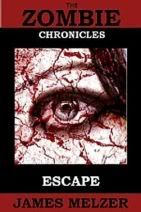 The Zombie Chronicles - Book 1: Escape has continued to feed this addiction. This is storytelling with bite.
I had my reservations, as I greatly fear all the cliches that are associated with zombies. Zombies have gone so far into the laughable in the past twenty-odd years that it's a he!! of a job trying to make them scary again. Somehow, Melzer has written a zombie book that at once encapsulates all those worn-out tropes and injects the zombie genre with a new lease on life.
(Ah, will the puns never end?)
From the first chapter, I was grabbed by the freshness of Melzer's writing, his wry wit and the way he pulls a middle finger at all the stale baggage that zombies bring with them. Despite the title, this is no 28 Days Later
. Without wanting to bring any spoilers to the table, I think it's safe to say that Melzer has single-handedly reinvented the zombie genre, while never abandoning everything we love about zombie stories - decaying flesh, the lust for human meat, brains exploding under well-aimed headshots.TZC brings unexpected twist after twist, none of which have any place in the story you think you're listening to. But Melzer pulls it off with style, wit and lots of disintegrating sinew. I almost panicked when iTunes wouldn't give me the last chapter. Desperate measures were taken to hear the last part of this book, I guarantee you.
If you're into zombies even a little bit, you must listen to this podcast - or buy the book, when it comes out later this year (full disclosure - I get nothing from promoting any of the podcasts I review. I just dig that these guys and girls are so cool about it). If you like a good action story, or anything with a twist, this is also brilliant.
The audio quality is faultless. Melzer pulls off his voices without any problem, and has chosen not to clutter up the soundscape with effects. I think that if a podcaster/audio producer has the means and the ear to do good music and effects, and it doesn't cut drastically into their available timeframes, and that if adding M&E really fleshes out the world, then they ought to do so. But if a writer embarking on the huge task of recording a podcast feels they don't have the means or the skills to do this well, I thank them for not ruining an otherwise good production with a subpar effects track. It's nice to just appreciate the writing and the performance for what they are.
(To those podcasters who do put in the effort and do it well, keep up the good work. I love it all!)
I highly enjoyed this podcast. What it may have lacked in substance, it made up for in plot twists, gunfights, and exploding heads. Having said that, I felt close enough to all the characters to really want to root for them, although I was never really sure if I could trust anyone at all. Fantastic stuff.
TZC gets a solid 4 1/2 Stars out of 5 from me.
Friday, May 8, 2009
Review: "Jack Wakes Up" by Seth Harwood
Originally Published at Freshly Ground on May 7th 2009
To celebrate Seth Harwood's novel Jack Wakes Up being released into bookstores across the USA this week, I took it upon myself to listen to the entire podcast over the past two days and throw out my thoughts on it.
 Jack Wakes Up is a bit of a step away from my usual cup of tea, being a crime novel and not in the slightest bit fantasy, horror, or science fiction. But it stood out to me, as crime fiction goes, in that the protagonist was not a cop or an ex-marine, but rather a washed-up actor.
Jack Palms has been on the wagon after his drug- and alcohol-fueled fall from grace some years earlier, which saw his marriage fall apart under the watching eyes of the public and the media. He's now cleaned himself up but is completely broke. A dodgy character from his past life entices him into doing one last big drug deal to set himself up for a while and make a new start.
As Jack gets drawn deeper into San Francisco's shady underworld, however, things quickly go from bad to worse.
Jack Wakes Up would fall somewhere between Lock Stock and Two Smoking Barrels and 2 Fast 2 Furious, were it to have been a film. There are drug deals, murders, gun fights, car chases, betrayals, and strip bars - everything you expect from a high-octane, fast-paced action story.
This was fun to listen to. In the world of action storytelling, JWU was an invigorating tale, a cracking good yarn with plenty of good laughs thrown in. If my impression is that this was perhaps a bit lighter than Harwood intended, it's only because last night I also finished listening to Scott Sigler's Nocturnal, which completely blew me away (and will be reviewed very shortly, I promise). By comparison, JWU was good relief.
The audio production was clean and uncluttered. Harwood obviously made a choice not to use any sound effects (or if he did, they were so well done that I didn't even notice them), and relied on his own delivery to carry the pace of the story. There is no music or atmos in the soundtrack apart from chapter breaks, but I don't think the production suffered for this at all. The writing itself is tidy and precise, and Harwood's diction is mostly faultless (apart from the occasional stumble which hasn't been edited out), so following the story is never an issue.
I played this podcast through my computer speakers in a busy workshop, and was very rarely either a) unclear as to what was going on, or b) suddenly aware that I had lost the thread. I was kept engaged throughout the reading, even with distractions, and always felt like I knew what was going on and where the characters were. This is a testament to Harwood's writing and delivery, since this podcast is really just the author reading his own story, with all the passion he can muster.
Nice one.
Overall I rate Jack Wakes Up at 4 Stars.
Recommended to anyone who likes a good gangster or crime story, or a bit of action. Jack Wakes Up is complete at 19 Chapters, plus a Q&A with Seventh Son author JC Hutchins, which is both entertaining and informative.
You can listen to the first chapter here. The rest of the podcast can be found at Harwood's website, totally free. The book is also available in US bookstores and online.
While we're talking about Seth Harwood, he has posted a really helpful video about how to go about recording a podcast, which I also recommend for the three minutes it'll take you, if that sounds like something you might be thinking about.
Jack Wakes Up is available from Amazon.com, and can be found in bookstores across the USA.
To celebrate Seth Harwood's novel Jack Wakes Up being released into bookstores across the USA this week, I took it upon myself to listen to the entire podcast over the past two days and throw out my thoughts on it.
Jack Wakes Up is a bit of a step away from my usual cup of tea, being a crime novel and not in the slightest bit fantasy, horror, or science fiction. But it stood out to me, as crime fiction goes, in that the protagonist was not a cop or an ex-marine, but rather a washed-up actor.Jack Palms has been on the wagon after his drug- and alcohol-fueled fall from grace some years earlier, which saw his marriage fall apart under the watching eyes of the public and the media. He's now cleaned himself up but is completely broke. A dodgy character from his past life entices him into doing one last big drug deal to set himself up for a while and make a new start.
As Jack gets drawn deeper into San Francisco's shady underworld, however, things quickly go from bad to worse.
Jack Wakes Up would fall somewhere between Lock Stock and Two Smoking Barrels and 2 Fast 2 Furious, were it to have been a film. There are drug deals, murders, gun fights, car chases, betrayals, and strip bars - everything you expect from a high-octane, fast-paced action story.
This was fun to listen to. In the world of action storytelling, JWU was an invigorating tale, a cracking good yarn with plenty of good laughs thrown in. If my impression is that this was perhaps a bit lighter than Harwood intended, it's only because last night I also finished listening to Scott Sigler's Nocturnal, which completely blew me away (and will be reviewed very shortly, I promise). By comparison, JWU was good relief.
The audio production was clean and uncluttered. Harwood obviously made a choice not to use any sound effects (or if he did, they were so well done that I didn't even notice them), and relied on his own delivery to carry the pace of the story. There is no music or atmos in the soundtrack apart from chapter breaks, but I don't think the production suffered for this at all. The writing itself is tidy and precise, and Harwood's diction is mostly faultless (apart from the occasional stumble which hasn't been edited out), so following the story is never an issue.
I played this podcast through my computer speakers in a busy workshop, and was very rarely either a) unclear as to what was going on, or b) suddenly aware that I had lost the thread. I was kept engaged throughout the reading, even with distractions, and always felt like I knew what was going on and where the characters were. This is a testament to Harwood's writing and delivery, since this podcast is really just the author reading his own story, with all the passion he can muster.
Nice one.
Overall I rate Jack Wakes Up at 4 Stars.
Recommended to anyone who likes a good gangster or crime story, or a bit of action. Jack Wakes Up is complete at 19 Chapters, plus a Q&A with Seventh Son author JC Hutchins, which is both entertaining and informative.
You can listen to the first chapter here. The rest of the podcast can be found at Harwood's website, totally free. The book is also available in US bookstores and online.
While we're talking about Seth Harwood, he has posted a really helpful video about how to go about recording a podcast, which I also recommend for the three minutes it'll take you, if that sounds like something you might be thinking about.
Jack Wakes Up is available from Amazon.com, and can be found in bookstores across the USA.
Wednesday, April 29, 2009
Review: "Eden" by Phil Rossi
Originally Published at Freshly Ground on April 28th 2009
A few weeks ago I wrote what I have decided, in hindsight, was an unnecessarily harsh review of the Sci-Fi/Horror epic podcast novel Crescent, by Phil Rossi. As I've said before, there is a huge difference between highly engineered audiobooks and works of individual labour, and having now thoroughly doused myself in hours of both, I can say with confidence that Crescent is a standout of the latter species.
On that note, anyone who has gone on to listen to Crescent, or anyone who may not be into audiobooks but loves to read a good bit of sci-fi, the book version of Crescent is going to be available on Amazon soon. Phil would like his fans who plan on buying a copy of the book to hold back until July 9th, and then to descend on Amazon like a swarm of angry hornets, pushing the book up the charts. I'll remind you all again closer to the time.
What I like about Rossi is how he has clung tight to everything about the internet that says "you can do it, if you stick with it." He's put everything out there for free, he's made himself accessible to his ever-growing fanbase, and he deserves to reap the rewards. It also proves that the cream really can rise to the top, and that there is no better weapon at a writer's disposal (good writing aside) than the art of self-promotion.
 So, moving on. Eden is complete at 8 episodes and available free either on Rossi's website, or through iTunes, or at Podiobooks.com. It's free in all of these places, and Podiobooks.com provides a donation service, from which the majority of the money goes direct to the author.
I'm not sure what I was expecting when I started listening to Eden, but I figured out pretty much straight away that this was not going to be a rehash of Crescent, despite my initial impressions. Eden is also set on a space station, but there the similarities with Crescent begin and end. I was expecting another action story, but Eden with its dark mystery delivered a much richer experience, which had me hanging out for each new episode.
Where Crescent is visually evocative and a tour-de-force of action and horror, Eden advances at a more cerebral pace. From the outset, Rossi's writing has improved by several degrees, so much so that I felt like I was listening to a different writer. As the writing has matured, so too has the story. Focused intently on the first-person narrator, Malcolm, who is dispatched to a tiny space station near the planet Uranus, Eden is as much about the enormous, mysterious tree that has been found growing in the void of space as it is about Malcolm, his failings, his self-doubt, and his weaknesses.
Woven into this is Rossi's blend of science fiction and Lovecraftian horror, as the station spirals further from safety and sanity and into the consuming madness of Eden. The first-person perspective also keeps you relentlessly close to the action, which makes listening to this story a painfully emotional journey, in a way that all but the best sci-fi and fantasy fails to do.
Eden doesn't drag you through the chapters with blood pumping in your ears and air rasping in your throat like Crescent. Rather, you find yourself being led, trying to turn away, your stomach a hollow pit, afraid of where the next turn is going to lead you, and cursing Malcolm for his crippling self-pity.
I score Eden 4 1/2 stars out of 5, and I seriously rate the quality of Rossi's writing on this novella. It is a good length; any longer and it would have needed a faster pace, any shorter and it would have felt rushed. Overall, and given that it is not a studio production but an individual effort, Eden is a stunner. Give it a listen.
A few weeks ago I wrote what I have decided, in hindsight, was an unnecessarily harsh review of the Sci-Fi/Horror epic podcast novel Crescent, by Phil Rossi. As I've said before, there is a huge difference between highly engineered audiobooks and works of individual labour, and having now thoroughly doused myself in hours of both, I can say with confidence that Crescent is a standout of the latter species.
On that note, anyone who has gone on to listen to Crescent, or anyone who may not be into audiobooks but loves to read a good bit of sci-fi, the book version of Crescent is going to be available on Amazon soon. Phil would like his fans who plan on buying a copy of the book to hold back until July 9th, and then to descend on Amazon like a swarm of angry hornets, pushing the book up the charts. I'll remind you all again closer to the time.
What I like about Rossi is how he has clung tight to everything about the internet that says "you can do it, if you stick with it." He's put everything out there for free, he's made himself accessible to his ever-growing fanbase, and he deserves to reap the rewards. It also proves that the cream really can rise to the top, and that there is no better weapon at a writer's disposal (good writing aside) than the art of self-promotion.
 So, moving on. Eden is complete at 8 episodes and available free either on Rossi's website, or through iTunes, or at Podiobooks.com. It's free in all of these places, and Podiobooks.com provides a donation service, from which the majority of the money goes direct to the author.
I'm not sure what I was expecting when I started listening to Eden, but I figured out pretty much straight away that this was not going to be a rehash of Crescent, despite my initial impressions. Eden is also set on a space station, but there the similarities with Crescent begin and end. I was expecting another action story, but Eden with its dark mystery delivered a much richer experience, which had me hanging out for each new episode.
Where Crescent is visually evocative and a tour-de-force of action and horror, Eden advances at a more cerebral pace. From the outset, Rossi's writing has improved by several degrees, so much so that I felt like I was listening to a different writer. As the writing has matured, so too has the story. Focused intently on the first-person narrator, Malcolm, who is dispatched to a tiny space station near the planet Uranus, Eden is as much about the enormous, mysterious tree that has been found growing in the void of space as it is about Malcolm, his failings, his self-doubt, and his weaknesses.
Woven into this is Rossi's blend of science fiction and Lovecraftian horror, as the station spirals further from safety and sanity and into the consuming madness of Eden. The first-person perspective also keeps you relentlessly close to the action, which makes listening to this story a painfully emotional journey, in a way that all but the best sci-fi and fantasy fails to do.
Eden doesn't drag you through the chapters with blood pumping in your ears and air rasping in your throat like Crescent. Rather, you find yourself being led, trying to turn away, your stomach a hollow pit, afraid of where the next turn is going to lead you, and cursing Malcolm for his crippling self-pity.
I score Eden 4 1/2 stars out of 5, and I seriously rate the quality of Rossi's writing on this novella. It is a good length; any longer and it would have needed a faster pace, any shorter and it would have felt rushed. Overall, and given that it is not a studio production but an individual effort, Eden is a stunner. Give it a listen.
Wednesday, April 22, 2009
Review: "DarkAge" by Kirk Warrington
Originally Published at Freshly Ground on April 21, 2009
After finishing Phil Rossi's Crescent and waiting in eager anticipation for the final chapters of Jack Kincaid's Hoad's Grim, my hunger for more good storytelling was ravenous. I took Phil Rossi's advice and headed to Podiobooks to hunt down another great listen, and found a huge list of books that sounded like they might appeal to me.
I spent some time downloading first chapters and loading them into a playlist on my Ipod, then listened to them in the car on the way home. The ones that grabbed me made it as far as being downloaded in full, and one of those was DarkAge by Kirk Warrington.
I would love to rave about how good this was. I'd love to say that it was hilarious and satisfying and well worth the listen, just because I don't really like to sound critical. Unfortunately, for all its good points, DarkAge ultimately let me down as a listener, and I would be hesitant to recommend it.
First and foremost, let me say again that I have a tremendous amount of respect for the amount of work that goes into not only writing a book (I've done that myself - phew!) but also into doing an audio production of any scale, much less the recording of a whole book. I've made short films and worked in the film industry for years, so I know there's no such thing as a "small project". So to Kirk W and Phil R and Jack K (and Derek Gilbert, whose book Iron Dragons I'm currently listening to, and Christoph Laputka, who produces the astounding Leviathan Chronicles) who go to all this effort, and do it all for free, I tip my hat. Sometimes, however, the mark is missed.
DarkAge reeled me in from the first chords of the crunching heavy metal guitar riff that frames each episode. The basic premise is that a group of people - in this case fantasy role-players - are magically swept away into another world where they find they have come to inhabit their characters from the game they were just playing. Suddenly, the risks they were so happy for their paper-based characters to face are more than just a game; they're deadly reality. As the story progresses, the characters realise that in order to survive in this harsh world, they must become their DarkAge characters. If they don't, they won't have those characters' skills that allow them to prosper as they would in the game. The option is penury and shame at best, and death at the worst.
In terms of theme, DarkAge seems to be about the struggle for integrity of one's own self when faced with the challenges of emerging into a world that is more brutal and real than you were ever prepared for. As a teen coming-of-age metaphor, DarkAge bundles up the fears and hopes that we all had and throws them at us in a bloody, bruising haze; responsibilities can be as much a burden as a blessing, and making the wrong choices has real consequences. Sometimes making those choices, even standing up for what you believe in, can be fatal.
The narrative was linear and uncomplicated, which sadly also left the character development sorely lacking. While we knew all the characters and understood their individual motives and desires reasonably well, the need to abandon their old selves to survive tended to force them all in a single direction, even those who resisted that change.
Where this really fell down for me, however, was that the hook in a story of this nature is that you want to know: How do they get home? Without wanting to spoil the book, suffice to say that this question is never answered in a manner that satisfied me, given the hours I spent listening to DarkAge. In fact, there were far too many questions of that nature, questions that are really the guts of a story of this kind, that were never answered. Instead, the story focused on the conflicts between the characters themselves and the people they meet in the world of Merinia, and we never get to really learn about what makes this world tick. Conflict and story are all good of course, but it came at the cost of world-building and character arcs.
While this left the story open to a lot of action and adventure, of which there is plenty, and a good dose of humour, much of it fairly ribald, DarkAge ultimately feels shallow and under-developed, like watching someone else play a hack-and-slash computer game.
Warrington uses the idea that this is not a parallel world but a game world to lampoon many of the ridiculous rules that abound in roleplaying, and in that he well and truly hits the mark. (I think I'm bleeding to death! / You Idiot! Just drink a healing potion!) [Not an actual quote, but you get the idea.]
The other three key elements of the podcast - namely performance, writing, and production - also need work.
Performance-wise, while Warrington's theatrical skills leave much to be desired, he was by no means the worst I've heard. His reading of the script was deliberate and came across as forced, but he was nothing if not clear. He also handled the large cast of characters well, creating unique and distinctive, if not necessarily brilliant, voices for all of them. Some were harder to pick than others, but Warrington's insistence on writing dense lines of verbiage to follow almost every mouthful of speech ensured that we always know who's talking.
Yet it was this verbosity which also made me grit my teeth while listening. I would think to myself, I don't need you to tell me that he said that with annoyance, I can tell from the dialogue and the tone. This over-writing slowed the story down and seldom added any illumination. I think it may have improved towards the end, however. With the help of a brutal editor this book could be tightened up tremendously and be a snappier, more captivating piece of sword-and-sorcery than it currently is.
The sound effects were the real low point. Like I said, good on you Kirk for even getting this far. I've been spoiled by podcasts like Leviathan, Hoad's Grim and Eden, which all have stunning audio production. But the cries of the demons in the last chapters just made me laugh, or at least groan. Any tension that had been built in any scene that those demons squealed in just went down the drain as soon as that noise came through the speakers. Surely there must be better Creative Commons 'Demon Screams' out there for people to use. Kincaid, any suggestions?
Overall, I'll say that I'm glad I stuck with it to the end, but it was getting to be a struggle, and I really wanted to see them get home. Given the ending, however, I guess there is a sequel in the wind. This had the potential to be a good read, but ultimately it failed to convince me. Unless you really love the "whisked away into a parallel/divergent universe" concept, I wouldn't recommend DarkAge. The high point is Warrington's ability to satirise the genre and the RPG world, and worth a listen if you like that sort of thing. I know I laughed more than I usually do reading fantasy or sci-fi, and for that I'm grateful. And while I'd like to know what happens to Kev and Vaughn and Sake and Jer, and James and Hades, I don't think I'll be rushing out to listen to the sequel.
2 1/2 Stars.
After finishing Phil Rossi's Crescent and waiting in eager anticipation for the final chapters of Jack Kincaid's Hoad's Grim, my hunger for more good storytelling was ravenous. I took Phil Rossi's advice and headed to Podiobooks to hunt down another great listen, and found a huge list of books that sounded like they might appeal to me.
I spent some time downloading first chapters and loading them into a playlist on my Ipod, then listened to them in the car on the way home. The ones that grabbed me made it as far as being downloaded in full, and one of those was DarkAge by Kirk Warrington.
I would love to rave about how good this was. I'd love to say that it was hilarious and satisfying and well worth the listen, just because I don't really like to sound critical. Unfortunately, for all its good points, DarkAge ultimately let me down as a listener, and I would be hesitant to recommend it.
First and foremost, let me say again that I have a tremendous amount of respect for the amount of work that goes into not only writing a book (I've done that myself - phew!) but also into doing an audio production of any scale, much less the recording of a whole book. I've made short films and worked in the film industry for years, so I know there's no such thing as a "small project". So to Kirk W and Phil R and Jack K (and Derek Gilbert, whose book Iron Dragons I'm currently listening to, and Christoph Laputka, who produces the astounding Leviathan Chronicles) who go to all this effort, and do it all for free, I tip my hat. Sometimes, however, the mark is missed.
DarkAge reeled me in from the first chords of the crunching heavy metal guitar riff that frames each episode. The basic premise is that a group of people - in this case fantasy role-players - are magically swept away into another world where they find they have come to inhabit their characters from the game they were just playing. Suddenly, the risks they were so happy for their paper-based characters to face are more than just a game; they're deadly reality. As the story progresses, the characters realise that in order to survive in this harsh world, they must become their DarkAge characters. If they don't, they won't have those characters' skills that allow them to prosper as they would in the game. The option is penury and shame at best, and death at the worst.
In terms of theme, DarkAge seems to be about the struggle for integrity of one's own self when faced with the challenges of emerging into a world that is more brutal and real than you were ever prepared for. As a teen coming-of-age metaphor, DarkAge bundles up the fears and hopes that we all had and throws them at us in a bloody, bruising haze; responsibilities can be as much a burden as a blessing, and making the wrong choices has real consequences. Sometimes making those choices, even standing up for what you believe in, can be fatal.
The narrative was linear and uncomplicated, which sadly also left the character development sorely lacking. While we knew all the characters and understood their individual motives and desires reasonably well, the need to abandon their old selves to survive tended to force them all in a single direction, even those who resisted that change.
Where this really fell down for me, however, was that the hook in a story of this nature is that you want to know: How do they get home? Without wanting to spoil the book, suffice to say that this question is never answered in a manner that satisfied me, given the hours I spent listening to DarkAge. In fact, there were far too many questions of that nature, questions that are really the guts of a story of this kind, that were never answered. Instead, the story focused on the conflicts between the characters themselves and the people they meet in the world of Merinia, and we never get to really learn about what makes this world tick. Conflict and story are all good of course, but it came at the cost of world-building and character arcs.
While this left the story open to a lot of action and adventure, of which there is plenty, and a good dose of humour, much of it fairly ribald, DarkAge ultimately feels shallow and under-developed, like watching someone else play a hack-and-slash computer game.
Warrington uses the idea that this is not a parallel world but a game world to lampoon many of the ridiculous rules that abound in roleplaying, and in that he well and truly hits the mark. (I think I'm bleeding to death! / You Idiot! Just drink a healing potion!) [Not an actual quote, but you get the idea.]
The other three key elements of the podcast - namely performance, writing, and production - also need work.
Performance-wise, while Warrington's theatrical skills leave much to be desired, he was by no means the worst I've heard. His reading of the script was deliberate and came across as forced, but he was nothing if not clear. He also handled the large cast of characters well, creating unique and distinctive, if not necessarily brilliant, voices for all of them. Some were harder to pick than others, but Warrington's insistence on writing dense lines of verbiage to follow almost every mouthful of speech ensured that we always know who's talking.
Yet it was this verbosity which also made me grit my teeth while listening. I would think to myself, I don't need you to tell me that he said that with annoyance, I can tell from the dialogue and the tone. This over-writing slowed the story down and seldom added any illumination. I think it may have improved towards the end, however. With the help of a brutal editor this book could be tightened up tremendously and be a snappier, more captivating piece of sword-and-sorcery than it currently is.
The sound effects were the real low point. Like I said, good on you Kirk for even getting this far. I've been spoiled by podcasts like Leviathan, Hoad's Grim and Eden, which all have stunning audio production. But the cries of the demons in the last chapters just made me laugh, or at least groan. Any tension that had been built in any scene that those demons squealed in just went down the drain as soon as that noise came through the speakers. Surely there must be better Creative Commons 'Demon Screams' out there for people to use. Kincaid, any suggestions?
Overall, I'll say that I'm glad I stuck with it to the end, but it was getting to be a struggle, and I really wanted to see them get home. Given the ending, however, I guess there is a sequel in the wind. This had the potential to be a good read, but ultimately it failed to convince me. Unless you really love the "whisked away into a parallel/divergent universe" concept, I wouldn't recommend DarkAge. The high point is Warrington's ability to satirise the genre and the RPG world, and worth a listen if you like that sort of thing. I know I laughed more than I usually do reading fantasy or sci-fi, and for that I'm grateful. And while I'd like to know what happens to Kev and Vaughn and Sake and Jer, and James and Hades, I don't think I'll be rushing out to listen to the sequel.
2 1/2 Stars.
Sunday, April 5, 2009
Review: "Hoad's Grim" by Jack Kincaid
Originally Published at Freshly Ground on April 4th 2009
Here we are, back again. I'd like to get straight into my review of Hoad's Grim, but first I need to say a few words about the Audiobook market and my previous review of Phil Rossi's Crescent. Mainly, it needs to be said that there are two (at least) very different creatures out there; the audio drama, and the author-read audiobook. Both are performance art, but they exist in different parts of the creative sphere, and I was in error to compare Hoad's Grim to Crescent in the first place.
Crescent was read and produced by the author, and since finishing Crescent I have listened to many more author-read podcasts, most of which I couldn't make it right through the first chapter of, either because of the quality of the performance or the audio itself, or because the story didn't grab me like I thought it would. Of all those I've listened to, Crescent still rates at the top (followed closely now by Eden, Phil Rossi's new podcast novella.).
Hoad's Grim, on the other hand, is a highly polished, magnificently produced audio performance, incorporating fantastic layerings of dialogue, sound effects and music. There are also multiple professional voice talents involved in this production, including the author Jack Kincaid and vocal maestro James "Killer" Keller, as well as the not inconsiderable audio production skills that Kincaid brings to bear on the work. Like The Leviathan Chronicles, Hoad's Grim is a lavish professional production, and needs to be considered as such.

Before you ask, Hoad's Grim is a horror story, so if the genre doesn't appeal, then I imagine that the audiobook won't. Non-aficionados of the horror genre are excused, and for those who are fans and wish to continue reading, I promise there will be no spoilers.
Except to say that this is about a haunted fridge. Oh yeah. Now that is a scary premise, all unto itself. It may sound odd and a bit lame, but I guarantee you it's not. I will never look at an old fridge rusting in an empty lot the same way again.
Before I started listening to this, I was an Audiobook virgin, and Hoad's Grim most definitely popped my cherry, and left me wanting more. As soon as I started listening to the prologue, I was transported to another time and place, and even into another mind. It was nothing like what I had expected, and I immediately wanted to hear more. The story hooks the listener in right from the start, as the multiple layers of speech, music, atmos and effects draw you down deeper into the dark and frankly terrifying world that Kincaid builds.
There is never any confusion about who is speaking at any time, or where the characters might be - unless Kincaid doesn't want you to know. And that just makes it all the more scary. Like a good horror movie, the frights in HG come as much from what you can't see or hear but from what you might sense on the edges of perception; the creeping sense of dread that clings to every darkened doorway and silent television conjured through words and sounds alone.
What really made HG work was its completely immersive experience. I listen to my audiobooks in the car driving to and from work, and when I had HG on, I could drive untold kilometres and only remember being on the windy, weed-choked curb of Saybrook Way, watching Chad "The Hammerman" Hyman struggle with the demons in his mind, and lurking in the shadows of that haunted street. It was like reading a book but better, because the voices were there, and the wind curled around their words, and the chittering of the dark creations that grew out of the shadows actually chittered across the speakers, scraping and clawing as if they sought their own way into the world.
I sat up in bed one night, with most of the lights off, listening, because I was really hooked on the story. I only did that once. I like my sleep.
Based on the folklore of the tommyknockers, HG plays on everyone's fear of unseen things that go bump in the night, and on the fear of being left alone in the dark with those things. The listener is left chilled by what the mind is not just encouraged to imagine, as in a book, but by those conjured horrors which you are forced to see in the darkness behind your own eyes as the audio landscape drags you into Kincaid's twisted nightmare.
If you like a good scare, then this comes highly recommended. Hoad's Grim is complete at 24 chapters and available free from Kincaid's site. I have been unable to fault HG, and I will probably listen to it again. I was going to say that I thought the last chapter had left a few too many loose ends, but then I realised that there was one more that I hadn't downloaded, so that puts a lid on that.
Absolutely brilliant. Whether you're a fan of horror and want to hear just how good an audiodrama can be, or if you love good audiobooks and are willing to dare the terrors that lurk in the Grim, do yourself a favour and listen to this.
Five Stars.
For more interesting info, you can check out this interview with Jack Kincaid and James Keller, by John Joseph Adams of Tor.com (Part 1; Part 2). This was the article that got me interested enough to listen to a story about a haunted fridge. Yip, a haunted fridge. Brilliant stuff.
Here we are, back again. I'd like to get straight into my review of Hoad's Grim, but first I need to say a few words about the Audiobook market and my previous review of Phil Rossi's Crescent. Mainly, it needs to be said that there are two (at least) very different creatures out there; the audio drama, and the author-read audiobook. Both are performance art, but they exist in different parts of the creative sphere, and I was in error to compare Hoad's Grim to Crescent in the first place.
Crescent was read and produced by the author, and since finishing Crescent I have listened to many more author-read podcasts, most of which I couldn't make it right through the first chapter of, either because of the quality of the performance or the audio itself, or because the story didn't grab me like I thought it would. Of all those I've listened to, Crescent still rates at the top (followed closely now by Eden, Phil Rossi's new podcast novella.).
Hoad's Grim, on the other hand, is a highly polished, magnificently produced audio performance, incorporating fantastic layerings of dialogue, sound effects and music. There are also multiple professional voice talents involved in this production, including the author Jack Kincaid and vocal maestro James "Killer" Keller, as well as the not inconsiderable audio production skills that Kincaid brings to bear on the work. Like The Leviathan Chronicles, Hoad's Grim is a lavish professional production, and needs to be considered as such.

Before you ask, Hoad's Grim is a horror story, so if the genre doesn't appeal, then I imagine that the audiobook won't. Non-aficionados of the horror genre are excused, and for those who are fans and wish to continue reading, I promise there will be no spoilers.
Except to say that this is about a haunted fridge. Oh yeah. Now that is a scary premise, all unto itself. It may sound odd and a bit lame, but I guarantee you it's not. I will never look at an old fridge rusting in an empty lot the same way again.
Before I started listening to this, I was an Audiobook virgin, and Hoad's Grim most definitely popped my cherry, and left me wanting more. As soon as I started listening to the prologue, I was transported to another time and place, and even into another mind. It was nothing like what I had expected, and I immediately wanted to hear more. The story hooks the listener in right from the start, as the multiple layers of speech, music, atmos and effects draw you down deeper into the dark and frankly terrifying world that Kincaid builds.
There is never any confusion about who is speaking at any time, or where the characters might be - unless Kincaid doesn't want you to know. And that just makes it all the more scary. Like a good horror movie, the frights in HG come as much from what you can't see or hear but from what you might sense on the edges of perception; the creeping sense of dread that clings to every darkened doorway and silent television conjured through words and sounds alone.
What really made HG work was its completely immersive experience. I listen to my audiobooks in the car driving to and from work, and when I had HG on, I could drive untold kilometres and only remember being on the windy, weed-choked curb of Saybrook Way, watching Chad "The Hammerman" Hyman struggle with the demons in his mind, and lurking in the shadows of that haunted street. It was like reading a book but better, because the voices were there, and the wind curled around their words, and the chittering of the dark creations that grew out of the shadows actually chittered across the speakers, scraping and clawing as if they sought their own way into the world.
I sat up in bed one night, with most of the lights off, listening, because I was really hooked on the story. I only did that once. I like my sleep.
Based on the folklore of the tommyknockers, HG plays on everyone's fear of unseen things that go bump in the night, and on the fear of being left alone in the dark with those things. The listener is left chilled by what the mind is not just encouraged to imagine, as in a book, but by those conjured horrors which you are forced to see in the darkness behind your own eyes as the audio landscape drags you into Kincaid's twisted nightmare.
If you like a good scare, then this comes highly recommended. Hoad's Grim is complete at 24 chapters and available free from Kincaid's site. I have been unable to fault HG, and I will probably listen to it again. I was going to say that I thought the last chapter had left a few too many loose ends, but then I realised that there was one more that I hadn't downloaded, so that puts a lid on that.
Absolutely brilliant. Whether you're a fan of horror and want to hear just how good an audiodrama can be, or if you love good audiobooks and are willing to dare the terrors that lurk in the Grim, do yourself a favour and listen to this.
Five Stars.
For more interesting info, you can check out this interview with Jack Kincaid and James Keller, by John Joseph Adams of Tor.com (Part 1; Part 2). This was the article that got me interested enough to listen to a story about a haunted fridge. Yip, a haunted fridge. Brilliant stuff.
Monday, March 2, 2009
Review: "Crescent" by Phil Rossi
Originally Published at Freshly Ground on March 1st 2009
Phil Rossi's Crescent is the second full-length podcast I've listened to, after the brilliant Hoad's Grim, which I'm still listening to as the episodes come down.
The quick review: Crescent was an enjoyable "read", keeping in mind that it is intended for a mature audience. It told a pacy and chilling tale of terror in deep space, carefully balancing horror with action. The characters were generally well-rounded and portrayed with a deft hand, and there are moments where the writing really shines. If you have the time to listen to the thirty-odd half-hour segments, and you can handle a bit of audio scare, then do yourself a favour and start downloading Crescent. It's free, BTW.
I've been playing them through my car radio on the way to work and home again. It's a great way to kill the commute.
In recent news regarding Crescent, it has apparently been picked up as both a book and a movie, which is fantastic news for the author, and further proof of how it can be really worthwhile to use the internet to build an audience by putting a product out there for free. I remember thinking to myself as I was listening how it might adapt well as a screenplay, so I wasn't actually surprised to hear this development.
Now, the longer review. Yes, I liked Crescent and I listened all the way to the end. I won't toss in any spoilers here, but I will just make mention of a few things I wasn't impressed by.
Admittedly, being hooked on Hoad's Grim - which is absolutely stunning as far as the story, writing, voice talent and audio production go - puts Crescent on a back foot from the word go. The Crescent podcast series utilises music from just one song throughout it's entire length, and this gets a bit repetitive. But it's a good song, so that's not a complaint. It's just that a bit of variety might have been better.
My main niggle with Crescent was that the author, Phil Rossi, made a decision to voice all the characters himself. OK, stop me please if this is common practice for podcasting and audiobooks, but I found it a bit frustrating. Particularly the women's voices all tended to sound the same. Like I've said, the vocal talent on Hoad's Grim leaves you in no doubt whatsoever who is talking at any point in time. I think that it might have been to the author's advantage to have drafted in some other voices for this job, just for the sake of clarity. However, this didn't make the story un-followable, it just made it obscure in places.
It was nice to hear, in the Notes from the Vault, which are a series of short fiction pieces written by the same author, that he did indeed bring in some other voice talent from time to time during their production. The Notes deserve a review too, but it won't be tonight.
As a writer, I felt that in places Rossi might have profited from having a keen editorial hand run over his work. There were occasional pieces of clunky dialogue and prose, and sections of writing which I can imagine working well on the page but which didn't translate to the soundwave very well. Still, this was a free work, a work of passion, and Rossi's writing seems to get better the more I listen to it, so that's a good sign.
I'm now listening to Eden (mp3 promo link), and I have yet to make a judgment. So far, it seems to be about a ... hmmm ... haunted space station ... with ... wait for it ...
No, no spoilers. Suffice to say that I'll be downloading the new chapter very shortly.
My last word on Crescent, after all that good stuff, is sadly one of just the mildest disappointment, not in the work itself, but in an epilogue that was released some time after the final chapter. Crescent ended with a hint of irresolution - of the temerity of the immortal, and the infinite hunger of the unknown, leaving the reader only with the comfort of knowing that our lead characters, whom we have grown to care for, will at least be free and clear of the horrors they have faced, even if those horrors do live on somehow. Then the epilogue unwound this comfort, which replaced that feeling of catharsis with one of frustration, as if we were suddenly back in the middle of a story that had yet to be told.
As underhanded openings to sequels go, this one really kicked sand in the listener's ears. I would rather not have listened to the epilogue. So if you decide to give Crescent the time it's worth, my one piece of advice is this: Don't download the Epilogue. It's a spoiler all of its own.
Apart from all that: 4 Stars from me.
Phil Rossi's Crescent is the second full-length podcast I've listened to, after the brilliant Hoad's Grim, which I'm still listening to as the episodes come down.
The quick review: Crescent was an enjoyable "read", keeping in mind that it is intended for a mature audience. It told a pacy and chilling tale of terror in deep space, carefully balancing horror with action. The characters were generally well-rounded and portrayed with a deft hand, and there are moments where the writing really shines. If you have the time to listen to the thirty-odd half-hour segments, and you can handle a bit of audio scare, then do yourself a favour and start downloading Crescent. It's free, BTW.
I've been playing them through my car radio on the way to work and home again. It's a great way to kill the commute.
In recent news regarding Crescent, it has apparently been picked up as both a book and a movie, which is fantastic news for the author, and further proof of how it can be really worthwhile to use the internet to build an audience by putting a product out there for free. I remember thinking to myself as I was listening how it might adapt well as a screenplay, so I wasn't actually surprised to hear this development.
Now, the longer review. Yes, I liked Crescent and I listened all the way to the end. I won't toss in any spoilers here, but I will just make mention of a few things I wasn't impressed by.
Admittedly, being hooked on Hoad's Grim - which is absolutely stunning as far as the story, writing, voice talent and audio production go - puts Crescent on a back foot from the word go. The Crescent podcast series utilises music from just one song throughout it's entire length, and this gets a bit repetitive. But it's a good song, so that's not a complaint. It's just that a bit of variety might have been better.
My main niggle with Crescent was that the author, Phil Rossi, made a decision to voice all the characters himself. OK, stop me please if this is common practice for podcasting and audiobooks, but I found it a bit frustrating. Particularly the women's voices all tended to sound the same. Like I've said, the vocal talent on Hoad's Grim leaves you in no doubt whatsoever who is talking at any point in time. I think that it might have been to the author's advantage to have drafted in some other voices for this job, just for the sake of clarity. However, this didn't make the story un-followable, it just made it obscure in places.
It was nice to hear, in the Notes from the Vault, which are a series of short fiction pieces written by the same author, that he did indeed bring in some other voice talent from time to time during their production. The Notes deserve a review too, but it won't be tonight.
As a writer, I felt that in places Rossi might have profited from having a keen editorial hand run over his work. There were occasional pieces of clunky dialogue and prose, and sections of writing which I can imagine working well on the page but which didn't translate to the soundwave very well. Still, this was a free work, a work of passion, and Rossi's writing seems to get better the more I listen to it, so that's a good sign.
I'm now listening to Eden (mp3 promo link), and I have yet to make a judgment. So far, it seems to be about a ... hmmm ... haunted space station ... with ... wait for it ...
No, no spoilers. Suffice to say that I'll be downloading the new chapter very shortly.
My last word on Crescent, after all that good stuff, is sadly one of just the mildest disappointment, not in the work itself, but in an epilogue that was released some time after the final chapter. Crescent ended with a hint of irresolution - of the temerity of the immortal, and the infinite hunger of the unknown, leaving the reader only with the comfort of knowing that our lead characters, whom we have grown to care for, will at least be free and clear of the horrors they have faced, even if those horrors do live on somehow. Then the epilogue unwound this comfort, which replaced that feeling of catharsis with one of frustration, as if we were suddenly back in the middle of a story that had yet to be told.
As underhanded openings to sequels go, this one really kicked sand in the listener's ears. I would rather not have listened to the epilogue. So if you decide to give Crescent the time it's worth, my one piece of advice is this: Don't download the Epilogue. It's a spoiler all of its own.
Apart from all that: 4 Stars from me.
Subscribe to:
Posts (Atom)


